The Universal Addressability of Dumb Things

The Universal Addressability of Dumb Things
20130622-094439.jpg

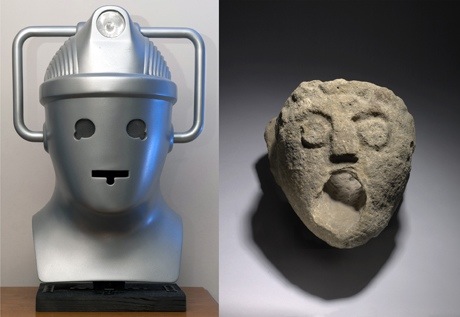
Cyberman with Gargoyle
Cyberman Helmet, 1985, Courtesy Chris Balcombe, Photo: Chris Balcombe
Singing Gargoyle, England, c. 1200, Courtesy of Sam Fogg, London

Curated by Mark Leckey

Turner Prize-winning artist Mark Leckey has curated an exhibition that explores the magical world of new technology, as well as tracing its connections to the beliefs of our distant past.

Historical and contemporary works of art, videos, machines, archaeological artefacts and iconic objects, like the giant inflatable cartoon figure of Felix the Cat – the first image ever transmitted on TV – inhabit an “enchanted landscape” created in the Pavilion’s galleries, where objects seem to be communicating with each other and with us.

In Leckey’s exhibition “magic is literally in the air.” It reflects on a world where technology can bring inanimate “things” to life. Where websites predict what we want, we can ask our mobile phones for directions and smart fridges suggest recipes, count calories and even switch on the oven. By digitising objects, it can also make them “disappear” from the material world, re-emerging in any place or era.

In this timeless exhibition, “the real and the virtual co-exist”, Leckey has said. Perhaps technology has created its own form of consciousness – an animistic future. While we already live in the realms of what used to be science fiction, we seem to have simultaneously gone back to our ancestral past – a time when ancient civilisations believed spirits inhabited plants, animals, geographic features and even objects.

Leckey’s theatre of “things” is presented in specially designed environments. Works by artists such as William Blake, Louise Bourgeois, Martin Creed, Richard Hamilton, Nicola Hicks, Jim Shaw and Tøyen are displayed alongside a medieval silver hand containing the bones of a saint, an electronic prosthetic hand that connects with Bluetooth, a bisected 3D model of Snoopy showing his internal organs, and many other treasures that all share connections. Loosely divided into four themes or scenes – the Vegetable World, Animal Kingdom, Mankind and the Technological Domain, Leckey’s exhibition is a collection of not-so-dumb things that all talk, literally or metaphorically, to each other.

Mark Leckey was born in Birkenhead in 1964. He currently teaches at Goldsmiths College, University of London. In 2008 he won the Turner Prize. Recent solo exhibitions include Work & Leisure at Manchester Art Gallery (2012), and See We Assemble at the Serpentine Gallery, London (2011). The Universal Addressability of Dumb Things is the latest in a series of artist-curated Hayward Touring exhibitions.

‘The status of objects’, Leckey argues, ‘is changing, and we are once again in thrall to an enchanted world full of transformations and correspondences, a wonderful instability between things animate and inanimate, animal and human, mental and material’. Our hyper-rationalism of modern technology has paradoxically produced its opposite, an ‘irrational’ magical realm – or as Marshall McLuhan, communication theorist, described “a resonating world akin to the old tribal echo chamber where magic will live again”.

A Hayward Touring exhibition from Southbank Centre, London

20130622-094236.jpg

Woofer Design by Sander Mulder
© Sander Mulder

De La Warr Pavilion
Marina
Bexhill On Sea
East Sussex
TN40 1DP
Box Office and information:
01424 229 111 or boxoffice@dlwp.com

Sat 13 Jul 2013-
Sun 20 Oct 2013
Tickets: Free entry

Booking & Information:
01424 229 111

///

On an Ungrounded Earth

On an Ungrounded Earth, by Ben Woodard

20130613-214516.jpg

On an Ungrounded Earth, by Ben Woodard. Brooklyn, New York: Punctum Books. 118 pages. $12.00, paper.

In a 2011 interview conducted by Bookfriendzy, when asked about why he started his multi-disciplinary journal Collapse, Robin Mackay said (and I’m doing my best to transcribe here), “There were a number of problems that it was designed to address, one of which is the problem of where philosophy can exist outside of the academic environment—because of certain constraints of the academic environment—and the way in which the discipline of philosophy is conducted and constrained, and the conviction that philosophy happens everywhere, not just in philosophy departments.”

It might sound obvious—and a little silly—to think about it that way but the idea of philosophy being created and consumed outside of academia is a relatively recent innovation. Collapse is merely one of several increasingly visible venues publishing philosophical thought outside “philosophy departments,” many of which have hefty presences on the web. Certainly towering figures such as Nick Land, whose writings span a huge variety of subjects, and Quentin Meillassoux, whose landmark 2006 text, After Finitude, helped usher in a new era of “modern” philosophy, have had a major influence over a new generation of thinkers, writers and artists looking to construct arguments without, as Mackay put it, constraints.

As philosophy has moved away from outmoded schools and systems of thought, it’s now acceptable—if not outwardly fashionable—for writers to include examples of both “high” and “low” culture to illustrate and support their points. This leads us to Ben Woodard’s absolutely astounding On an Unground Earth, in which Woodard samples from a dizzying array of literature and media, all primarily centered around the disciplines of philosophy, science-fiction and horror. (Here’s a brief list of references: Deleuze and Guattari, Ray Brassier, Iain Hamilton Grant, Reza Negarestani, Jules Verne, Edgar Allan Poe, H.P. Lovecraft, Thomas Ligotti, Dune, Tremors, Star Trek, Star Wars, The Matrix series, The Technodrome from Teenage Mutant Ninja Turtles, Gears of War, Doom 3 and Dead Space—among many, many others.)

The subtitle of On an Ungrounded Earth is “Toward a New Geophilosophy.” As the back cover copy states, “In far too much continental philosophy, the Earth is a cold, dead place enlivened only by human thought—either as a thing to be exploited, or as an object of nostalgia.” One of Woodard’s contemporaries, Eugene Thacker, has written that there are three ways of interpreting the world as we know it: 1) the world-for-us, or the world in which we live; 2) the world-in-itself, or the inaccessible world which we then turn into the world-for us; and 3) the world-without-us, or the spectral and speculative world. In these terms then, Woodard’s Ungrounded Earth seeks to explore the relationship between human consciousness and the world-without-us.

Arranged in five sections—and despite its relatively brief page count—the text of On an Ungrounded Earth covers quite a bit of…well, ground. Abyssal and external “ungroundings,” giant worms, the panic of burial, the “dimensions” of hell, volcanic orifices—these are only a few of the topics explored. Because this is philosophy, and so much of the text builds off of ideas and concepts introduced in earlier passages, it’s difficult to pull any excerpts without disrupting Woodard’s meticulous terminology and contextualized language. Suffice it to say, that language is approachable and articulate. I wouldn’t exactly go so far as to call it accessible, but it’s certainly very readable. Overall, an excellent balance is struck between introducing new ideas, analyzing those ideas and explaining how everything relates back to the core idea of the book.

Part of that core is a deeply rooted fascination with the idea of philosophy itself, of “philosophically experiencing” the earth as we have come to understand it. On an Ungrounded Earth is one of an increasing number of texts that might be best described as speculative realism. Characterized by strong undercurrents of “anti-correlationism,” or, an outright rejection to Kant’s idea that we are limited to the correlation between thinking and being, speculative-realist texts are enjoying a good amount of attention in times of ecological imbalance and chaotic world trends. In 2013, a lot of us have spent the majority of our lives with the Internet. We have a constant supply of too much information—the anxiety of a shrinking world. We’ve long-ago accepted the idea of the universe expanding, seen a hundred movies depicting the destruction of our planet and helplessly witnessed the major religions of the world clash with one another again and again. Perhaps this is it. Perhaps whatever meaning there is to be found isn’t contained in the world-for-us. Perhaps, Woodard urges, the meaning we seek is right under our very feet—and has been for quite some time.

***

David Peak’s most recent book, Glowing in the Dark, was released by Aqueous Books in October, 2012. He is co-founder of Blue Square Press, an imprint of Mud Luscious Press, and lives in New York City.

///

Speculations

20130605-194320.jpg
Speculations IV, June 2013, ISBN: 978-0615797861

20130605-194341.jpg
If philosophy begins in wonder, then where does it end? What is its end? Aristotle said that while it begins in wondrous questioning, it ends with “the better state” of attaining answers, like an itch we get rid of with a good scratch or a childhood disease that, once gotten over, never returns. How depressing! Why can’t a good question continue being questionable or, in a more literal translation of the German, “question-worthy?” As Heidegger puts it, “philosophical questions are in principle never settled as if some day one could set them aside.” Couldn’t we learn from questions without trying to settle them, resolve ourselves to not resolving them? Couldn’t wisdom be found in reconciling ourselves to its perpetual love, and never its possession? Wittgenstein once wrote that “a philosophical problem has the form: ‘I don’t know my way about,’” which was the symptom of the deep confusion that constituted philosophy for him. But Heidegger loved wandering aimlessly in the woods, following Holzwege or paths that lead nowhere, stumbling onto dead-ends which could also be clearings.

–Lee Braver, “On Not Settling the Issue of Realism”

Download Speculations IV as a PDF.

Purchase print edition HERE.

–TABLE OF CONTENTS–

Editorial Introduction

PART I: REFLECTIONS

On Not Settling the Issue of Realism
Lee Braver

Politics and Speculative Realism
Levi R. Bryant

The Current State of Speculative Realism
Graham Harman

Weird Reading
Eileen A. Joy

A Very Dangerous Supplement: Speculative Realism, Academic Blogging, and the Future of Philosophy
Adam Kotsko

Speculative Realism: Interim Report with Just a Few Caveats
Christopher Norris

The Future of an Illusion
Jon Roffe

Realism and Representation: On the Ontological Turn
Daniel Sacilotto

PART II: PROPOSALS

“The World is an Egg”: Realism, Mathematics, and the Thresholds of Difference
Jeffrey A. Bell

Ontological Commitments
Manuel DeLanda

The Meaning of “Existence” and the Contingency of Sense
Markus Gabriel

Post-Deconstructive Realism: It’s About Time
Peter Gratton

Points of Forced Freedom: Eleven (More) Theses on Materialism
Adrian Johnston

Realism and the Infinite
Paul M. Livingston

How to Behave Like a Non-Philosopher, or, Speculative Versus Revisionary Metaphysics
John Mullarkey

“The Horror of Darkness”: Toward an Unhuman Phenomenology
Dylan Trigg

///

UCL’s Documentary Film Festival UCL

UCL’s Documentary Film Festival

20130530-202103.jpg

UCL hosts the third edition of Open City Docs Fest in venues across campus and beyond, June 20-23.
This is London’s only documentary festival – a gift from UCL to our global city.

Bringing together some of the best filmmakers in the world and the researchers upon whom their films so often rely, the festival creates conversations in and around film.

The festival will screen over 90 films. The best will be judged by a jury chaired by actor turned documentarist, Jeremy Irons. He is joined by our own departing Provost, Malcolm Grant, and others from the world of film and academia.

Open City aims to be much more than a film festival. UCL academics introduce the films, provide screen notes for the audiences, chair post-screening discussions, and participate in numerous panel events. This year panels range from the future of copyright in the age of the internet to the challenges and rewards of studies that run across the life course, from 7UP to Birth Cohort studies.

You can visit our website for details of all events and booking arrangements