
“42 Nights in Wonderland”
Photography and the Archive Research Centre (PARC) is an organisation in London that commissions new research into photography and culture, curates and produces exhibitions and publications, organises seminars, study days, symposia[1] and conferences, and supervises PhD students. It is a part of University of the Arts London (UAL), is based at UAL’s London College of Communication at Elephant & Castle[2] and was designated by UAL in 2003.
According to PARC’s website its activities span the history and culture of photography, particularly post-war British photography, the documentation of war and conflict, the photography of fashion and style, the visualization of the counterculture and photographers as filmmakers.
[hide]
Val Williams is its director and Brigitte Lardinois its deputy director. The Centre has a core group of members including Tom Hunter, Alistair O’Neill, Patrick Sutherland, Wiebke Leister, Jennifer Good (née Pollard), David Moore, Paul Lowe, Corinne Silva, Paul Tebbs, Mark Ingham, Martina Caruso, Peter Cattrell, Monica Biaglioli, Anne Williams, Jananne Al-Ani, Sophy Rickett, Joanna Love and Sara Davidmann. Current staff are Corinne Silva (Research Fellow), Robin Christian (Projects Manager) and Melanie King (Research Administrator).
Many of PARC’s activites are conducted in conjunction with other arts organisations and universitities including University of Sunderland, National Media Museum in Bradford, Library of Birmingham, Canterbury Christ Church University, Street Level Photoworks in Glasgow, Wolverhampton Art Gallery, Ffotogallery in Cardiff, Imperial War Museum in London, Photoworks in Brighton, University of Western Ontario in Canada, Expressions of Humankind and Max Ström publishers in Stockholm, Sune Jonsson Archive in Umea, Tate Modern and University of Wales, Newport.
Two of PARC’s divisions are War and Conflict Research Hub and Photography and the Contemporary Imaginary Research Hub.
PARC publishes Fieldstudy twice yearly, both in print and online, covering projects from PARC’s staff, members and students.
PARC and Bloomsbury co-host the journal Photography & Culture, co-edited by Kathy Kubicki, Thy Phu and Val Williams, published three times a year by Berg.[3]
PARC leads the Directory of Photographic Collections in the UK, a portal to UK institutions holding publicly accessible photographic collections.
PARC currently houses three collections within its archive, ‘Camerawork’, ‘Photography Exhibition Posters’ and ‘The John Wall archive of the Directory of British Photographic Collections in the UK’. ‘Photography Exhibition Posters’ is a collection of over 300 posters dating back to the 1970s that features examples of partnerships between designers and galleries. The ‘Camerawork’ collection includes papers and objects from the Half Moon Photography Workshop and Camerawork’s early years, publication and touring exhibition programme. ‘The John Wall archive of the Directory of British Photographic Collections in the UK’ includes correspondence, research papers and file cards of this 1970s project.
ART III
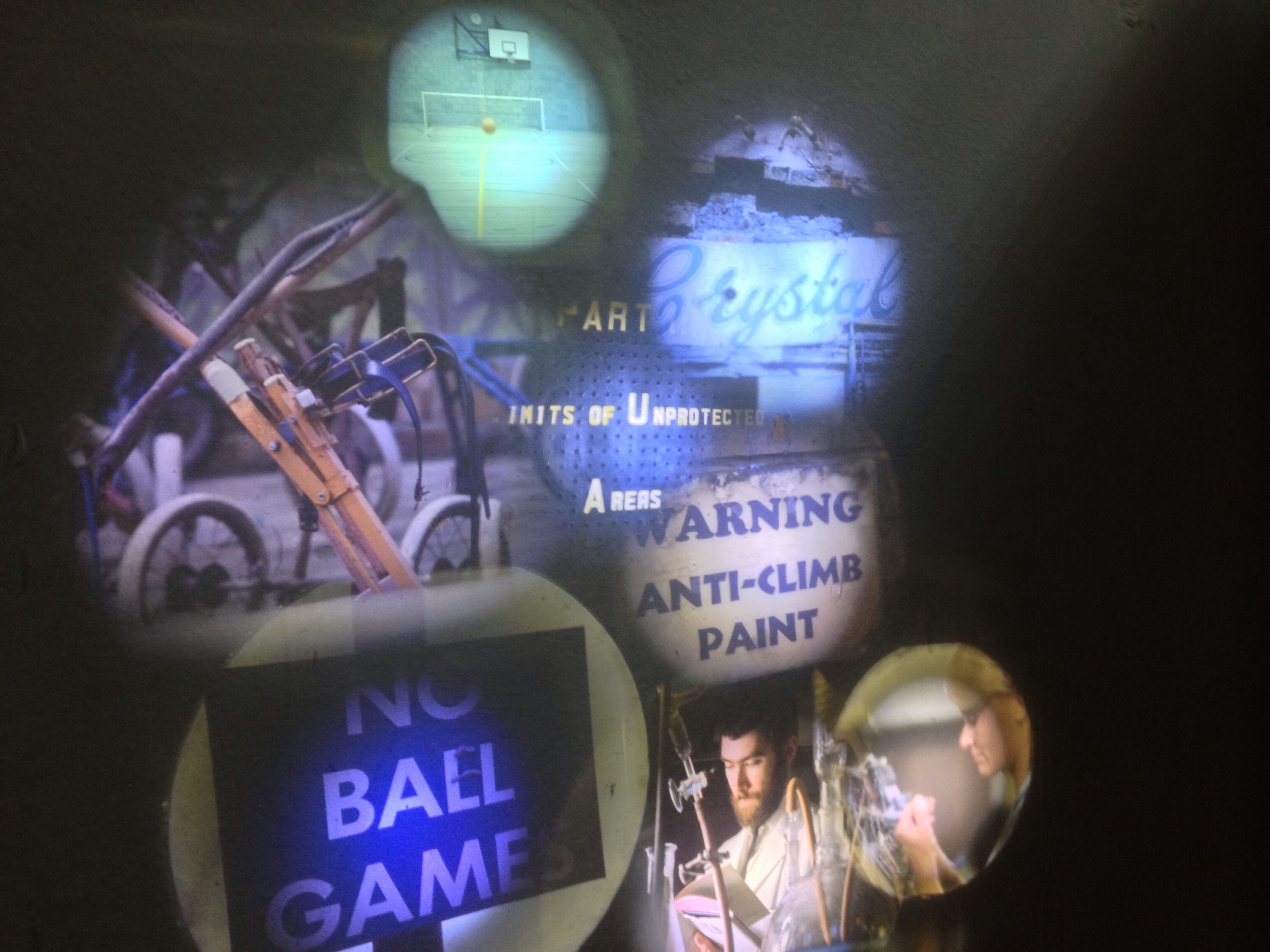
Limits of Unprotected
AREAS
Doomed Gallery
Ridley Road
London E8
19.00 24.07.2014
http://t.co/WDbMBla30R



A one-day symposium sponsored by LCC, HEA-ADM and the Writing PAD network.
Start Time: 10.00 am
Location: London College of Communication

Background
The ‘Screen Writes’ Symposium to be held on 27 June at LCC will explore the purposes and practices of writing as practice for BA students engaged in visual communication, including graphic design, advertising and animation. The idea of a symposium has sprung from the new ‘writing and blogging’ course for Level 1 students at the London College of Communication (Mark Ingham, with Andrea Mason, Linda Stupart, Andrew Slatter and Harriet Edwards): this will be critically analysed. The emphasis more generally is on writing practices emergent from studio concerns in line with the ethos of the Writing PAD project and its subsequent network. There will be time to discuss and exchange across roles and institutions in this symposium.
The ‘Screen Writes’ symposium is intent on exploring a number of interconnected areas related to graduate attributes. Firstly, the role of creative writings in relation to voice and identity through the daily and weekly practice of making the student’s writing public using online presences, in this case a practice/theory blog. This allows the students to see writing as going from being a fairly passive, summatively driven activity, to one that is in constant formation.
Secondly, it will explore the inherent mix that writing has with image and graphics in visual communication practices. This includes the surveying of tools and techniques employed when using online presences and how these can be used in such things as peer-to-peer learning. The idea that design and media students are writing with images will be analysed and challenged at this symposium. It will explore the possibilities of writing from images, writing with images, writing to images and writing against images. The beaten paths of these long and often debated relationships in academic writing will be taken off track to see if the clichés that surround these interactions in academia can be torn apart and reworked into more productive dynamic exchanges.
Thirdly, the potential of such practices to create a presence in social medias with a view to professional purposes, or how blogging, and indeed tweeting, can link the students to communities and prospective avenues beyond the university, will be scrutinised. Students have been encouraged to think about their online presences in a number of ways. As a digital note book/sketchbook where ideas can be drafted, edited, reworked and published. It also made the students think about who they were writing for in a professional context.
Fourthly, the articulation of the place, and merit of such practices within the wider design curriculum will be discussed. This will be in relation to employers wanting to see, not only a finished portfolio website that is demanded by the profession and academia, but a blog type site that also show the thinking, mistakes and the processes through to the making of final works.
10.00 Coffee
10.30 Introduction to the day, Mark Ingham
11am Writing as a creative activity for BA design (workshop,) Andrea Mason and Andrew Slatter
12.00 The pedagogy of creative writing – in the context of design (talk), Andrea Mason
12.30 Graphic design and writing, Andrew Slatter
1pm Lunch (Supplied by LCC)
1.45 “eRTFs” (Enriched Text Formats) Online, continuous and present writing in Art and Design Contextual & Theoretical lessons, Mark Ingham
2.30 The Myth of Creativity: How ‘creative writing’ in arts and design courses fails as effective/affective to, Linda Stupart
3pm Tea break
3.30 Screens and writes: what kinds of intelligences? Harriet Edwards
4-5 Discussion and exchange in small group; final feedback
We have some space for participants outside LCC itself to write-up their own practice OR responses to the day, with images or as a visual essay for Writing PAD’s Journal of Writing in Creative Practice (Intellect).
Attendance is free of charge with preference being given to staff in HE institutions and FE colleges across the UK. Places will be allocated on a first come, first served basis. Lunch and refreshments will be provided, but travel expenses will not be covered. However, the HEA is currently running a funding scheme to support travel crossing national borders to attend events, which could be applied for independently. For more information visit the HEA UK Travel Fund.
We have 32 places available on this day.
To book a place, please email:
Dr Harriet Edwards
(Journal Editor)
Or: Dr Mark Ingham
COMMON-PRACTISE
artistsaboutsubmitzine
MARK INGHAM
http://www.common-practise.com/markingham1
1 2 3 4 5 6 7 8 9 10 11 12 info
© Mark Ingham 2014
MARK INGHAM
‘..an ever always changing, cav, cav, cavor, cavorting carousel, that documents the transitory lives that pass, pass, pass, through our crystalline worlds.’
120 Days and Nights of STAGGERING + STAMMERING.
The young man at the beginning of Andrei Tarkovsky’s The Mirror stammers and stutters, and then learns not to.
My grandmother, Rose-Marie, staggers out of The China Hall Public House, The White Horse Tavern, The Crystal Tavern, The Eagle and never learns. In the icy wastes of the French Alps she dives into freezing lakes. Followed by my grandfather, without a St. Bernard dog for company. ‘Ice, No Brandy’. The very very late night Troy Bar in Soho always clings.
However far I try and get away from ‘Grey Gardens’ it still tugs me back to ‘Tea for Two’. Just tea for two and two for tea Just me for you Just tea for two and two for tea Just me for you.
Our lives are smeared throughout the world, recalled through disparate, dissolute, fragmentary images, sounds and memories.
On the 27 of December 1960 Marilyn Monroe gave birth to a baby boy. Two weeks earlier she had flown to the town of Pointe-à-Pierre in Trinidad and Tobago to give birth. The father is unknown. She gave it up for adoption immediately. A Mexican divorce was granted to Arthur Miller and Marilyn Monroe on January 24, 1961. The boy, weighing 6lbs and 12oz was adopted by Sheila and Stephen Ingham
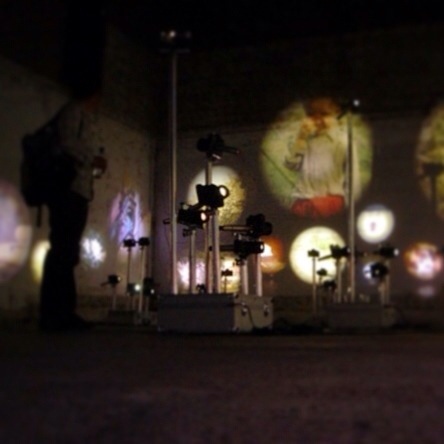
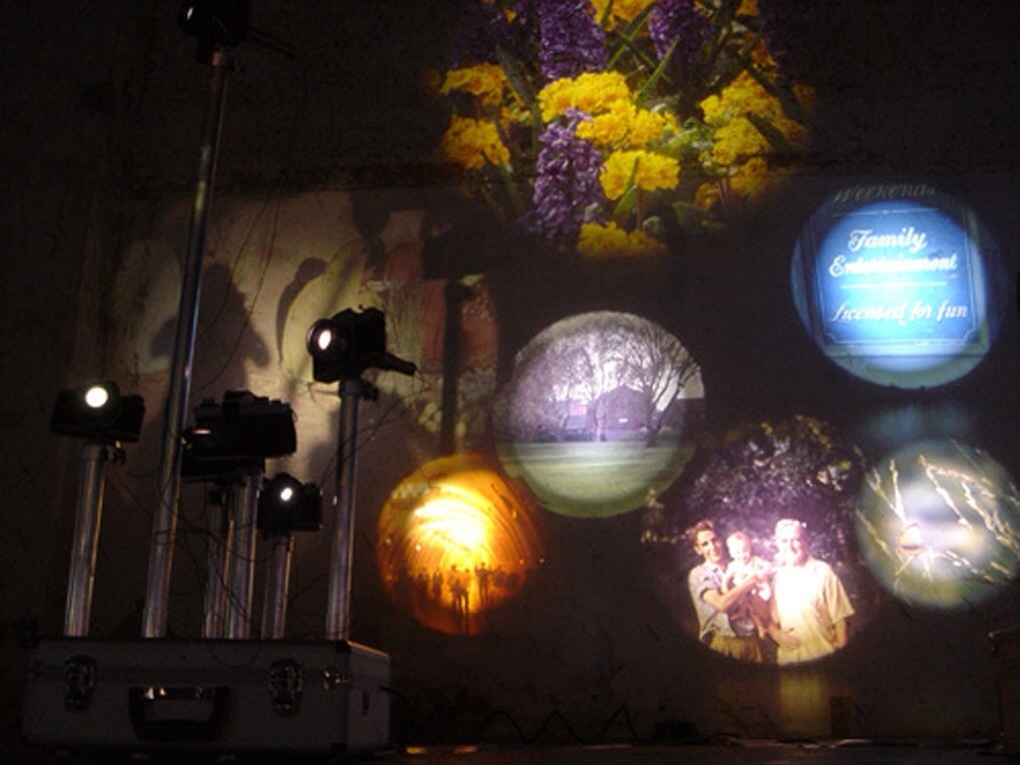
120 Days and Nights of STAGGERING + STAMMERING is an installation that sucks in and spews out images of the people and surroundings it encounters, real or imaginary, wherever it happens to stumble: New York, London, Venice, Iquitos, Ocho Rios.
Consisting of old SLR film cameras and LED spotlights each of the 120 ‘projectors’ throws out images of people, events and the fabric surrounding wherever it is exhibited. A dense flickering array of images negotiated and dictated by the space, can be projected into, onto and outwards of any given situation/site. They prefer shady aspects but can flourish during daylight hours too. The larger less bright images are made visible by the descending gloom of the night. The smaller, closer to the wall/ceiling/floor, ones can cope with the intensity of other light sources.
The projectors can be clumped together in one location or be spread around different locales as needs be. The audience is enveloped in and disrupts this cacophony of images, creating and destroying as they wander through and around them. Shadows will appear and obliterate the wall images only to reappear on the bodies of the transgressors. The images will be instantly recognisable, as they will depict places just passed through on the way to the exhibition site.
There will be temporal shifts occurring sometimes of mere days alongside others of an indeterminate age. Referents will be lost and gained throughout this encounter.
‘…an ever changing, cavorting carousel, that documents the transitory lives that pass through our crystalline world.’
The End The End To be continued…..
markingham.org
WORK


 Mark Ingham