Screen Writes

UAL      Writing PAD        HEA

Screen Writes

A one-day symposium sponsored by LCC, HEA-ADM and the Writing PAD network.

Date: Friday, June 27, 2014   

Start Time: 10.00 am

Location: London College of Communication

Room T304 (Tower Block)


Too Much

Background

The ‘Screen Writes’ Symposium to be held on 27 June at LCC will explore the purposes and practices of writing as practice for BA students engaged in visual communication, including graphic design, advertising and animation. The idea of a symposium has sprung from the new ‘writing and blogging’ course for Level 1 students at the London College of Communication (Mark Ingham, with Andrea Mason, Linda Stupart, Andrew Slatter and Harriet Edwards): this will be critically analysed. The emphasis more generally is on writing practices emergent from studio concerns in line with the ethos of the Writing PAD project and its subsequent network. There will be time to discuss and exchange across roles and institutions in this symposium.

The ‘Screen Writes’ symposium is intent on exploring a number of interconnected areas related to graduate attributes.  Firstly, the role of creative writings in relation to voice and identity through the daily and weekly practice of making the student’s writing public using online presences, in this case a practice/theory blog. This allows the students to see writing as going from being a fairly passive, summatively driven activity, to one that is in constant formation.

Secondly, it will explore the inherent mix that writing has with image and graphics in visual communication practices. This includes the surveying of tools and techniques employed when using online presences and how these can be used in such things as peer-to-peer learning. The idea that design and media students are writing with images will be analysed and challenged at this symposium. It will explore the possibilities of writing from images, writing with images, writing to images and writing against images. The beaten paths of these long and often debated relationships in academic writing will be taken off track to see if the clichés that surround these interactions in academia can be torn apart and reworked into more productive dynamic exchanges.

Thirdly, the potential of such practices to create a presence in social medias with a view to professional purposes, or how blogging, and indeed tweeting, can link the students to communities and prospective avenues beyond the university, will be scrutinised.  Students have been encouraged to think about their online presences in a number of ways. As a digital note book/sketchbook where ideas can be drafted, edited, reworked and published. It also made the students think about who they were writing for in a professional context.

Fourthly, the articulation of the place, and merit of such practices within the wider design curriculum will be discussed. This will be in relation to employers wanting to see, not only a finished portfolio website that is demanded by the profession and academia, but a blog type site that also show the thinking, mistakes and the processes through to the making of final works.

Programme

10.00      Coffee

10.30      Introduction to the day, Mark Ingham

11am       Writing as a creative activity for BA design (workshop,) Andrea Mason and Andrew Slatter

12.00      The pedagogy of creative writing – in the context of design  (talk), Andrea Mason

12.30       Graphic design and writing, Andrew Slatter

1pm         Lunch (Supplied by LCC)

1.45         “eRTFs” (Enriched Text Formats) Online, continuous and present writing in Art and Design Contextual & Theoretical lessons, Mark                       Ingham

2.30         The Myth of Creativity: How ‘creative writing’ in arts and design courses fails as effective/affective to, Linda Stupart

3pm        Tea break

3.30         Screens and writes: what kinds of intelligences? Harriet Edwards

4-5           Discussion and exchange in small group; final feedback

We have some space for participants outside LCC itself to write-up their own practice OR responses to the day, with images or as a visual essay for Writing PAD’s Journal of Writing in Creative Practice (Intellect).

Free but please book

Attendance is free of charge with preference being given to staff in HE institutions and FE colleges across the UK. Places will be allocated on a first come, first served basis. Lunch and refreshments will be provided, but travel expenses will not be covered. However, the HEA is currently running a funding scheme to support travel crossing national borders to attend events, which could be applied for independently. For more information visit the HEA UK Travel Fund.

We have 32 places available on this day.

To book a place, please email:

Dr Harriet Edwards

h.edwards@csm.arts.ac.uk

(Journal Editor)

Or: Dr Mark Ingham

m.ingham@lcc.arts.ac.uk

← Back

Thank you for your response. ✨

COMMON-PRACTISE

COMMON-PRACTISE
artistsaboutsubmitzine
MARK INGHAM

http://www.common-practise.com/markingham1

1 2 3 4 5 6 7 8 9 10 11 12 info

© Mark Ingham 2014

20140525-172330-62610609.jpg

20140525-172342-62622948.jpg

MARK INGHAM
‘..an ever always changing, cav, cav, cavor, cavorting carousel, that documents the transitory lives that pass, pass, pass, through our crystalline worlds.’
120 Days and Nights of STAGGERING + STAMMERING.
The young man at the beginning of Andrei Tarkovsky’s The Mirror stammers and stutters, and then learns not to.
My grandmother, Rose-Marie, staggers out of The China Hall Public House, The White Horse Tavern, The Crystal Tavern, The Eagle and never learns. In the icy wastes of the French Alps she dives into freezing lakes. Followed by my grandfather, without a St. Bernard dog for company. ‘Ice, No Brandy’. The very very late night Troy Bar in Soho always clings.
However far I try and get away from ‘Grey Gardens’ it still tugs me back to ‘Tea for Two’. Just tea for two and two for tea Just me for you Just tea for two and two for tea Just me for you.
Our lives are smeared throughout the world, recalled through disparate, dissolute, fragmentary images, sounds and memories.
On the 27 of December 1960 Marilyn Monroe gave birth to a baby boy. Two weeks earlier she had flown to the town of Pointe-à-Pierre in Trinidad and Tobago to give birth. The father is unknown. She gave it up for adoption immediately. A Mexican divorce was granted to Arthur Miller and Marilyn Monroe on January 24, 1961. The boy, weighing 6lbs and 12oz was adopted by Sheila and Stephen Ingham
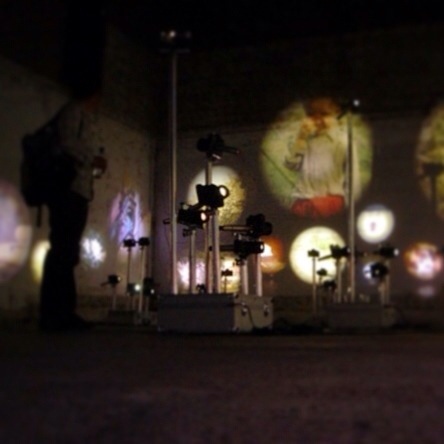
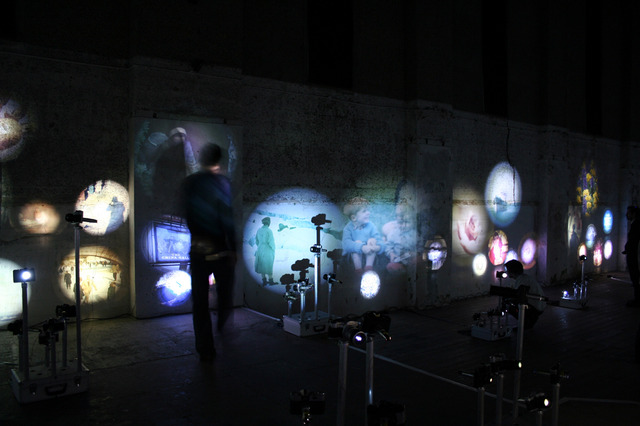
120 Days and Nights of STAGGERING + STAMMERING is an installation that sucks in and spews out images of the people and surroundings it encounters, real or imaginary, wherever it happens to stumble: New York, London, Venice, Iquitos, Ocho Rios.
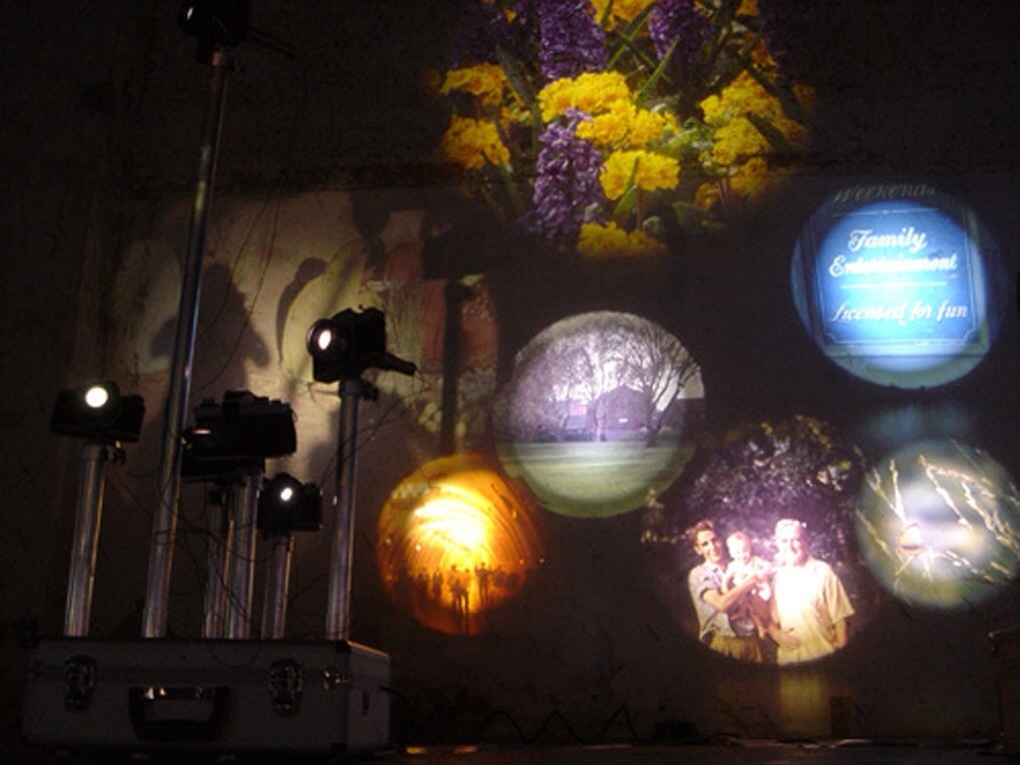
Consisting of old SLR film cameras and LED spotlights each of the 120 ‘projectors’ throws out images of people, events and the fabric surrounding wherever it is exhibited. A dense flickering array of images negotiated and dictated by the space, can be projected into, onto and outwards of any given situation/site. They prefer shady aspects but can flourish during daylight hours too. The larger less bright images are made visible by the descending gloom of the night. The smaller, closer to the wall/ceiling/floor, ones can cope with the intensity of other light sources.
The projectors can be clumped together in one location or be spread around different locales as needs be. The audience is enveloped in and disrupts this cacophony of images, creating and destroying as they wander through and around them. Shadows will appear and obliterate the wall images only to reappear on the bodies of the transgressors. The images will be instantly recognisable, as they will depict places just passed through on the way to the exhibition site.
There will be temporal shifts occurring sometimes of mere days alongside others of an indeterminate age. Referents will be lost and gained throughout this encounter.
‘…an ever changing, cavorting carousel, that documents the transitory lives that pass through our crystalline world.’
The End The End To be continued…..

markingham.org
WORK

It’s delicate … but potent.

120 Days Title v2

This slideshow requires JavaScript.

120 Days and Nights of Staggering and Stammering: Installation shots (SLR film Cameras, Slides. LED spotlights. + as a Digital Print)

///

Trending Creators at SEE.ME

https://mima27.see.me/

///

c

‘120 Days & Nights of Staggering & Stammering: Red Square Pet Heaven’ (SLR film Cameras, Slides. LED spotlights. + as a Digital Print)


‘120 Days & Nights of Staggering & Stammering: All the Fun of the Family’ (SLR film Cameras, Slides. LED spotlights. + as a Digital Print)

IMG_1481

‘120 Days and Nights of Staggering and Stammering’ (SLR film Cameras, Slides. LED spotlights. + as a Digital Print)

x///

Carousel/Carousal

“My first job, I was in house at a fur company, with this old pro copyrighter, a Greek named Teddy. 
And Teddy told me the most important idea in advertising is “new”. Creates an itch.
You simply put your product in there as a kind of … calamine lotion.
He also talked about a deeper bond with the product.

Nostalgia.

It’s delicate … but potent.

Teddy told me that in Greek, nostalgia literally means the pain from an old wound. 
It’s a twinge in your heart far more powerful than memory alone.
This device isn’t a spaceship.
It’s a time machine.

It goes backwards, forwards.
It takes us to a place where we ache to go again.
It’s not called the Wheel.x

It’s called the Carousel.

It lets us travel the way a child travels. 
Around and around and back home again…x

to a place where we know we are loved.”

– From Mad Men, Season One, Episode 13, “The Wheel”

In this scene, Don Draper (Jon Hamm) gives his advertising pitch to Kodak for their new slide projector, which they have not named yet.


////

memory-machine-image

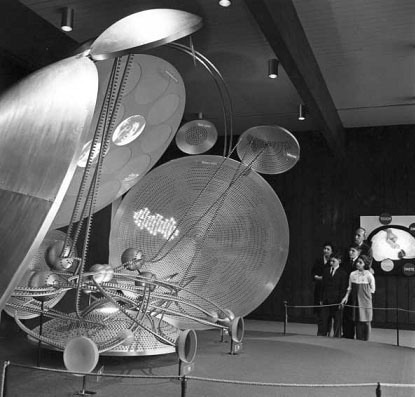
A display about memory at the Dittrick medical history center (1966)

Now at the College of Arts & Sciences of Case Western Reserve University in Cleveland, Ohio 

///

“The magical power of the projected image is unique to the medium.

A beam of light, thrown out from the slide or film projector, bears sequences of images  

that reconstitute and take form when the light meets an opaque surface.

Projected images are at once solid and transparent…

The beam of light is a powerful sign of memory and the visual imagination.

It transmits ghost images, figures that live only through the power of the projective

apparatus and die as the picture vanishes. Projected in darkness, the cone of light

traces the genesis of the images from projector to screen.

It is spellbinding and full of promise”

– Lynda Nead, The Haunted Gallery: Painting, Photography and Film around 1900

///

120 Days & Nights of Staggering & Stammering: Vampire Days.  
SLR film Cameras, Slides. LED spotlights. + as a Digital Print

///

x

ART TAKES LONDON | FEATURED ARTIST: MARK INGHAM

Mark Ingham‘s incredible installation, 120 Days and Nights of Staggering and Stammering, 

is designed from 120 SLR film cameras and LED spotlights. Each of these handmade projectors 

will display images taken before and during the installation, as well as audience-donated images.

Regardless of where Ingham’s piece is installed, the end result will reflect the experience

of the viewer within it.”  

Artists Wanted

x

///

120 days 3

“Ars Magna Lucis et Umbrae” 
Dilston Grove, Cafe Gallery Projects. 2008

x

///

Link: Go to Works 

x

TCoE Inside 1

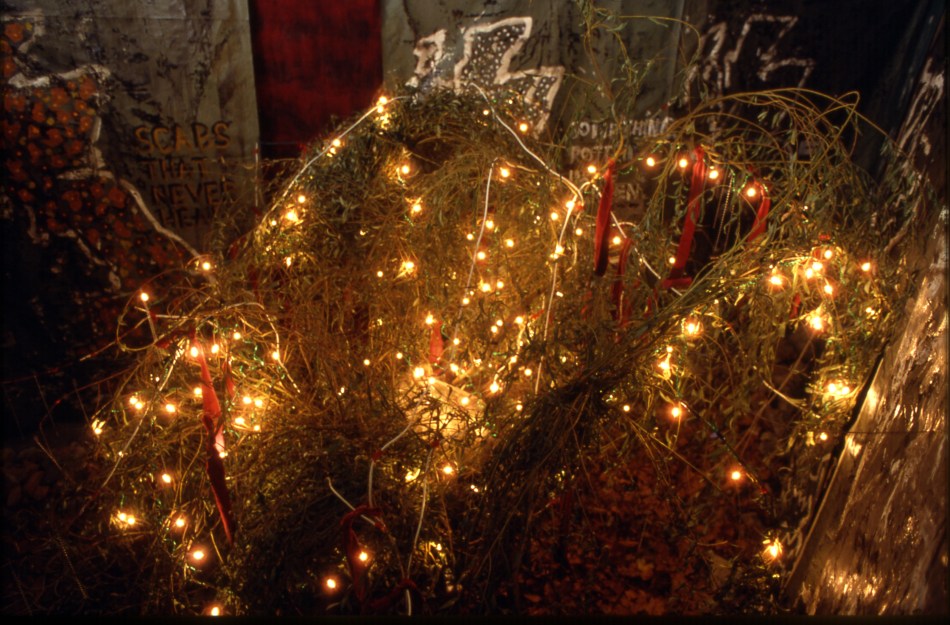
“England’s Dirty Rotten Gardens” 1988  (The Consumption of Elements) Chisenhale Gallery London

x

///

x

“A concept is a brick. It can be used to build a courthouse of reason. 

Or it can be thrown through the window.”

x

“Gilles Deleuze & Felix Guattari (A Thousand Plateaus: Capitalism and Schizophrenia. p xiii)

x

///

Crossroads

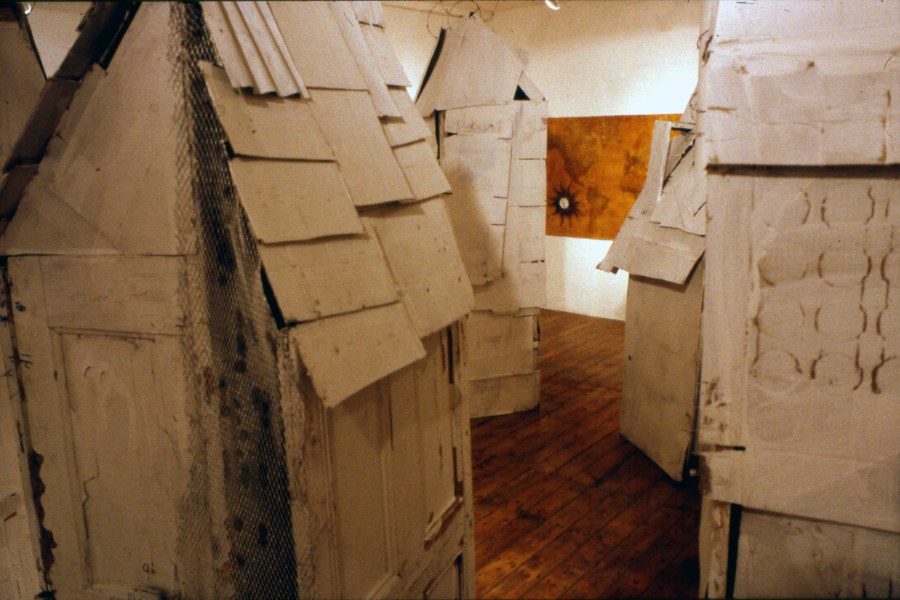
Crossroads 1986 In New British Sculpture, Air Gallery
Radios, Cardboard, Maps, Clocks, Barbed Wire.
x

///

x

“Technology is not neutral. We’re inside of what we make, and it’s inside of us.

We’re living in a world of connections —

and it matters which ones get made and unmade.” 

x

Donna Haraway (A Cyborg Manifesto. pp.149-181)

x

///

DIAGRA~1

Camera Projectors Diagram. 2005

///

x

“We have to see creation as tracing a path between impossibilities.” 

x

Gilles Deleuze  (Negotiations? & Essays Critical and Clinical. p x|viii)

x

///

10MarkIngham

“Ars Magna Lucis et Umbrae” 
Dilston Grove, Cafe Gallery Projects. 2008

///

x

“Art struggles with chaos but it does so in order to render it sensory….” (Watteau)

x

Gilles Deleuze and Felix Guattari.  (What is Philosophy? p205)

x

///

Doppelganger 3 Kings

Döppelganger: “We Three Kings…”  
2005  (Photographic Print 160 cm x 240 cm)

///

x

“Break a vase, and the love that reassembles the fragments is stronger than that love

which took its symmetry for granted when it was whole.” 

x

Derek Walcott (The Antilles: Fragments of Epic Memory. Nobel Lecture .1992)

x

///

Dr Mark Ingham 

View Mark Ingham's profile on LinkedIn

///

Twitter: (@ArsLucia)
Linkedin: (Mark Ingham)
Email: (markingham3@hotmail.com)

PDF CVMarkIngham2012CV

CV/Contact Page

← Back

Thank you for your response. ✨

[contact-field label="Name" type="name" required="1"/][contact-field label="Email" type="email" required="1"/][contact-field label="Website" type="url"/][contact-field label=’Comment’ type=’textarea’

///</script>


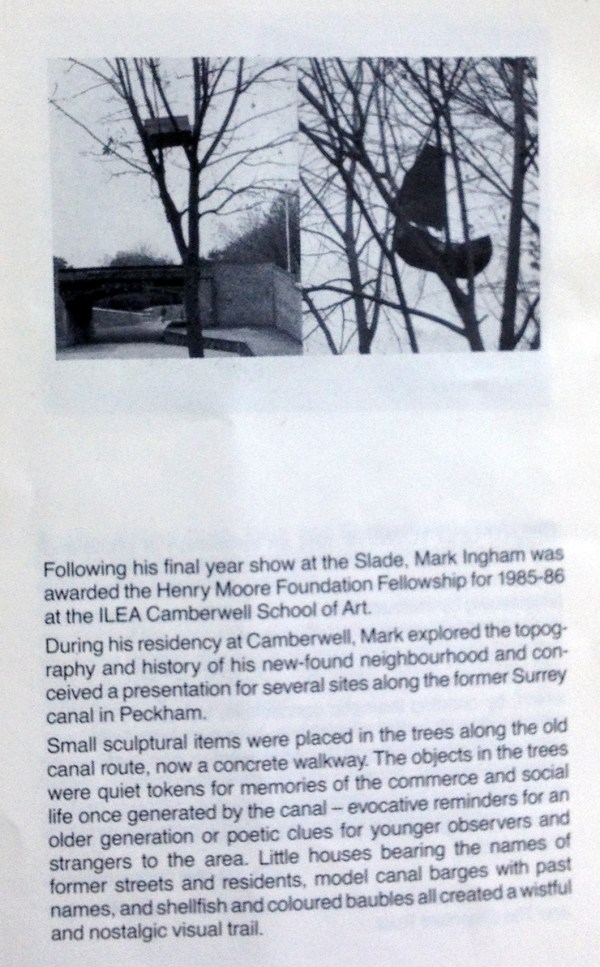
Paradise in Peckham

Paradise in Peckham 

An Artangel  Trust project. 

Installation along the former Surrey Canal,

Peckham. 1985. 

Artamgel MI PinP

///

///

///

///

Artangel Trust Cover

///

///

Artangel MI page cropped

///

Back to Works

///

The Essayification of Everything

The Essayification of Everything
By CHRISTY WAMPOLE
May 26, 2013

Lately, you may have noticed the spate of articles and books that take interest in the essay as a flexible and very human literary form. These include “The Wayward Essay” and Phillip Lopate’s reflections on the relationship between essay and doubt, and books such as “How to Live,” Sarah Bakewell’s elegant portrait of Montaigne, the 16th-century patriarch of the genre, and an edited volume by Carl H. Klaus and Ned Stuckey-French called “Essayists on the Essay: Montaigne to Our Time.”

It seems that, even in the proliferation of new forms of writing and communication before us, the essay has become a talisman of our times. What is behind our attraction to it? Is it the essay’s therapeutic properties? Because it brings miniature joys to its writer and its reader? Because it is small enough to fit in our pocket, portable like our own experiences?

I believe that the essay owes its longevity today mainly to this fact: the genre and its spirit provide an alternative to the dogmatic thinking that dominates much of social and political life in contemporary America. In fact, I would advocate a conscious and more reflective deployment of the essay’s spirit in all aspects of life as a resistance against the zealous closed-endedness of the rigid mind. I’ll call this deployment “the essayification of everything.”

What do I mean with this lofty expression?

Francis Bacon painted by Paul van Somer, circa 1600.
HULTON ARCHIVE / GETTY IMAGES
Let’s start with form’s beginning. The word Michel de Montaigne chose to describe his prose ruminations published in 1580 was “Essais,” which, at the time, meant merely “Attempts,” as no such genre had yet been codified. This etymology is significant, as it points toward the experimental nature of essayistic writing: it involves the nuanced process of trying something out. Later on, at the end of the 16th century, Francis Bacon imported the French term into English as a title for his more boxy and solemn prose. The deal was thus sealed: essays they were and essays they would stay. There was just one problem: the discrepancy in style and substance between the texts of Michel and Francis was, like the English Channel that separated them, deep enough to drown in. I’ve always been on Team Michel, that guy who would probably show you his rash, tell you some dirty jokes, and ask you what you thought about death. I imagine, perhaps erroneously, that Team Francis tends to attract a more cocksure, buttoned-up fan base, what with all the “He that hath wife and children hath given hostages to fortune; for they are impediments to great enterprises,” and whatnot.

With such divergent progenitors, the essay has never recovered from this chronic undecidability. As a genre that emerged to accommodate the expressive needs of the Renaissance Man, the essay necessarily keeps all tools and skills at its disposal. The essayist samples more than a D.J.: a loop of the epic here, a little lyric replay there, a polyvocal break and citations from greatnesses past, all with a signature scratch on top.

There is certainly disagreement on the wobbly matter of what counts as an essay and what does not. I have generally found that for every rule I could establish about the essay, a dozen exceptions scuttle up. I recently taught a graduate seminar on the topic and, at the end of the course, to the question “What can we say of the essay with absolute certainty?,” all of us, armed with our panoply of canonical essay theories and our own conjectures, had to admit that the answer is: “Almost nothing.” But this is the force of the essay: it impels you to face the undecidable. It asks you to get comfortable with ambivalence.

When I say “essay,” I mean short nonfiction prose with a meditative subject at its center and a tendency away from certitude. Much of the writing encountered today that is labeled as “essay” or “essay-like” is anything but. These texts include the kind of writing expected on the SAT, in seminar papers, dissertations, professional criticism or other scholarly writing; politically engaged texts or other forms of peremptory writing that insist upon their theses and leave no room for uncertainty; or other short prose forms in which the author’s subjectivity is purposely erased or disguised. What these texts often have in common is, first, their self-conscious hiding of the “I” under a shroud of objectivity. One has to pretend that one’s opinions or findings have emanated from some office of higher truth where rigor and science are the managers on duty.

Michel de Montaigne
HULTON ARCHIVE / GETTY IMAGES
Second, these texts are untentative: they know what they want to argue before they begin, stealthily making their case, anticipating any objections, aiming for air-tightness. These texts are not attempts; they are obstinacies. They are fortresses. Leaving the reader uninvited to this textual engagement, the writer makes it clear he or she would rather drink alone.

What is perhaps most interesting about the essay is what happens when it cannot be contained by its generic borders, leaking outside the short prose form into other formats such as the essayistic novel, the essay-film, the photo-essay, and life itself. In his unfinished novel “The Man Without Qualities,” the early 20th-century Austrian writer Robert Musil coined a term for this leakage. He called it “essayism” (Essayismus in German) and he called those who live by it “possibilitarians” (Möglichkeitsmenschen). This mode is defined by contingency and trying things out digressively, following this or that forking path, feeling around life without a specific ambition: not for discovery’s sake, not for conquest’s sake, not for proof’s sake, but simply for the sake of trying.

The possibilitarian is a virtuoso of the hypothetical. One of my dissertation advisers Thomas Harrison wrote a handsome book on the topic called “Essayism: Conrad, Musil, and Pirandello,” in which he argues that the essayism Musil sought to describe was a “solution in the absence of a solution,” a fuzzy response to Europe’s precarity during the years he worked on his unfinishable masterpiece. I would argue that many of us in contemporary America these days are prone to essayism, in various guises, but always in the spirit of open-endedness and with serious reservations about committing to any one thing.

Essayism consists in a self-absorbed subject feeling around life, exercising what Theodor Adorno called the “essay’s groping intention,” approaching everything tentatively and with short attention, drawing analogies between the particular and the universal. Banal, everyday phenomena — what we eat, things upon which we stumble, things that Pinterest us — rub elbows implicitly with the Big Questions: What are the implications of the human experience? What is the meaning of life? Why something rather than nothing? Like the Father of the Essay, we let the mind and body flit from thing to thing, clicking around from mental hyperlink to mental hyperlink: if Montaigne were alive today, maybe he too would be diagnosed with A.D.H.D.

The essayist is interested in thinking about himself thinking about things. We believe our opinions on everything from politics to pizza parlors to be of great import. This explains our generosity in volunteering them to complete strangers. And as D.I.Y. culture finds its own language today, we can recognize in it Arthur Benson’s dictum from 1922 that, “An essay is a thing which someone does himself.”

In Italian, the word for essay is “saggio” and contains the same root as the term “assaggiare,” which means to sample, taste or nibble food. Today, we like to sample, taste or nibble experiences: Internet dating, speed dating, online shopping and buy-and-try consumerism, mash-ups and digital sampling, the money-back guarantee, the temporary tattoo, the test-drive, shareware. If you are not satisfied with your product, your writing, your husband, you may return/delete/divorce it. The essay, like many of us, is notoriously noncommittal.

I certainly don’t argue that no one is committing these days; it only takes a few moments of exposure to contemporary American political discourse to realize the extent of dogmatic commitment to this or that party, to this or that platform. However, for many, the certainty with which the dogmatists make their pronouncements feels increasingly like a bothersome vestige of the past. We can either cling rigidly to dissolving categories or we can let ambivalence wash over us, allowing its tide to carry us toward new life configurations that were inconceivable even 20 years ago. Essayism, when imagined as a constructive approach to existence, is a blanket of possibilities draped consciously on the world.

Essayism is predicated on at least three things: personal stability, technocratic stability and societal instability.

Montaigne certainly possessed the first. He grew up in a privileged family, spoke Latin before French, had the educational, financial and social means to lead a life of civic engagement and writing. While most of us probably didn’t know fluent Latin as children (and never will) and aren’t in a position to become high-ranking civil servants, we have a relatively high literacy rate and unprecedented access to technologies of communication and reserves of knowledge. Furthermore, as a counter-narrative to our supposed busy-ness, there’s lots of evidence that we have plenty of idle time on our hands. Despite our search for distractions in any form, these empty hours give us time to contemplate the hardships of contemporary life. The thoughts just creep in if given the means.

Regarding technocracy, the maturation of print culture during the Renaissance meant that the great texts of Antiquity and newer philosophical, literary and scientific materials could reach a wider audience, albeit mainly composed of people of privilege. The experts of science and technology at that time siphoned some of the power that had been monopolized by the church and the crown. We could draw a similar analogy today: Silicon Valley and the technocratic business class still force the church and the state to share much of their cultural power. The essay thrives under these conditions.

As for societal instability, life outside Montaigne’s château was not rosy: the Wars of Religion between Catholics and Protestants raged in France starting in the 1560s. Turmoil and uncertainty, dogmatism and blood: such circumstances make one reflect on the meaning of life, but it is sometimes too hard to look such a question right in the face. Instead, one asks it obliquely by wondering about those smallnesses that make up the human experience. Today, unresolved issues of class, race, gender, sexual orientation, political affiliation and other categories have created a volatile social dynamic, and, with our current economic instability to boot, it is no wonder that throwing oneself wholeheartedly toward any particular idea or endeavor seems a risky proposition to many of us. Finally, the bloody wars of religion and ideology continue to rage on in our time. In the early 20th century, when the French writer André Malraux predicted that the 21st century would be a century of renewed mysticism, he perhaps did not imagine that the pursuit of God would take such a politically volatile form.

Essayism, as an expressive mode and as a way of life, accommodates our insecurities, our self-absorption, our simple pleasures, our unnerving questions and the need to compare and share our experiences with other humans. I would argue that the weakest component in today’s nontextual essayism is its meditative deficiency. Without the meditative aspect, essayism tends toward empty egotism and an unwillingness or incapacity to commit, a timid deferral of the moment of choice. Our often unreflective quickness means that little time is spent interrogating things we’ve touched upon. The experiences are simply had and then abandoned. The true essayist prefers a more cumulative approach; nothing is ever really left behind, only put aside temporarily until her digressive mind summons it up again, turning it this way and that in a different light, seeing what sense it makes. She offers a model of humanism that isn’t about profit or progress and does not propose a solution to life but rather puts endless questions to it.

We need a cogent response to the renewed dogmatism of today’s political and social landscape and our intuitive attraction to the essay could be pointing us toward this genre and its spirit as a provisional solution. Today’s essayistic tendency — a series of often superficial attempts relatively devoid of thought — doesn’t live up to this potential in its current iteration, but a more meditative and measured version à la Montaigne would nudge us toward a calm taking into account of life without the knee-jerk reflex to be unshakeably right. The essayification of everything means turning life itself into a protracted attempt.

The essay, like this one, is a form for trying out the heretofore untried. Its spirit resists closed-ended, hierarchical thinking and encourages both writer and reader to postpone their verdict on life. It is an invitation to maintain the elasticity of mind and to get comfortable with the world’s inherent ambivalence. And, most importantly, it is an imaginative rehearsal of what isn’t but could be.

RELATED: “How to Live Without Irony” by Christy Wampole.

Christy Wampole is an assistant professor of French at Princeton University. Her research focuses primarily on 20th- and 21st-century French and Italian literature and thought.