It’s delicate … but potent.

120 Days Title v2

This slideshow requires JavaScript.

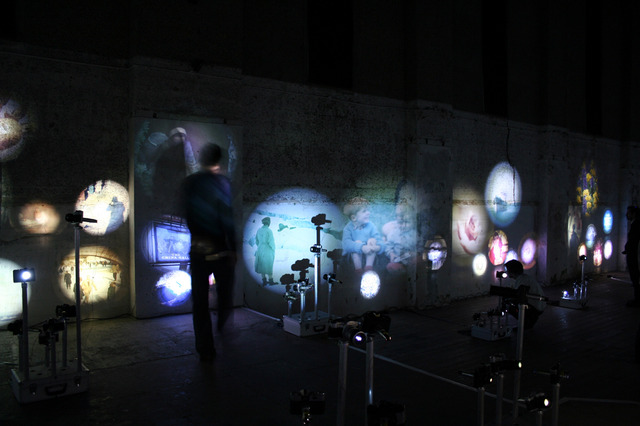
120 Days and Nights of Staggering and Stammering: Installation shots (SLR film Cameras, Slides. LED spotlights. + as a Digital Print)

///

Trending Creators at SEE.ME

https://mima27.see.me/

///

c

‘120 Days & Nights of Staggering & Stammering: Red Square Pet Heaven’ (SLR film Cameras, Slides. LED spotlights. + as a Digital Print)


‘120 Days & Nights of Staggering & Stammering: All the Fun of the Family’ (SLR film Cameras, Slides. LED spotlights. + as a Digital Print)

IMG_1481

‘120 Days and Nights of Staggering and Stammering’ (SLR film Cameras, Slides. LED spotlights. + as a Digital Print)

x///

Carousel/Carousal

“My first job, I was in house at a fur company, with this old pro copyrighter, a Greek named Teddy. 
And Teddy told me the most important idea in advertising is “new”. Creates an itch.
You simply put your product in there as a kind of … calamine lotion.
He also talked about a deeper bond with the product.

Nostalgia.

It’s delicate … but potent.

Teddy told me that in Greek, nostalgia literally means the pain from an old wound. 
It’s a twinge in your heart far more powerful than memory alone.
This device isn’t a spaceship.
It’s a time machine.

It goes backwards, forwards.
It takes us to a place where we ache to go again.
It’s not called the Wheel.x

It’s called the Carousel.

It lets us travel the way a child travels. 
Around and around and back home again…x

to a place where we know we are loved.”

– From Mad Men, Season One, Episode 13, “The Wheel”

In this scene, Don Draper (Jon Hamm) gives his advertising pitch to Kodak for their new slide projector, which they have not named yet.


////
memory-machine-image

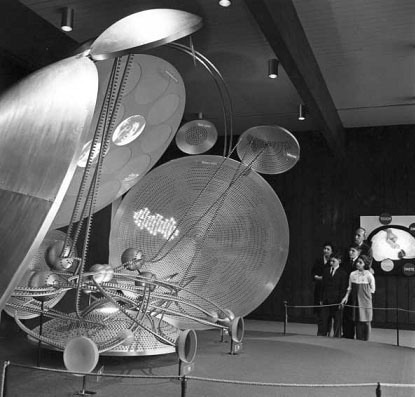
A display about memory at the Dittrick medical history center (1966)

Now at the College of Arts & Sciences of Case Western Reserve University in Cleveland, Ohio 

///

“The magical power of the projected image is unique to the medium.

A beam of light, thrown out from the slide or film projector, bears sequences of images  

that reconstitute and take form when the light meets an opaque surface.

Projected images are at once solid and transparent…

The beam of light is a powerful sign of memory and the visual imagination.

It transmits ghost images, figures that live only through the power of the projective

apparatus and die as the picture vanishes. Projected in darkness, the cone of light

traces the genesis of the images from projector to screen.

It is spellbinding and full of promise”

– Lynda Nead, The Haunted Gallery: Painting, Photography and Film around 1900

///

120 Days & Nights of Staggering & Stammering: Vampire Days.  
SLR film Cameras, Slides. LED spotlights. + as a Digital Print

///

x

ART TAKES LONDON | FEATURED ARTIST: MARK INGHAM

Mark Ingham‘s incredible installation, 120 Days and Nights of Staggering and Stammering, 

is designed from 120 SLR film cameras and LED spotlights. Each of these handmade projectors 

will display images taken before and during the installation, as well as audience-donated images.

Regardless of where Ingham’s piece is installed, the end result will reflect the experience

of the viewer within it.”  

Artists Wanted

x

///

120 days 3

“Ars Magna Lucis et Umbrae” 
Dilston Grove, Cafe Gallery Projects. 2008

x

///

Link: Go to Works 

x

TCoE Inside 1

“England’s Dirty Rotten Gardens” 1988  (The Consumption of Elements) Chisenhale Gallery London

x

///

x

“A concept is a brick. It can be used to build a courthouse of reason. 

Or it can be thrown through the window.”

x

“Gilles Deleuze & Felix Guattari (A Thousand Plateaus: Capitalism and Schizophrenia. p xiii)

x

///
Crossroads

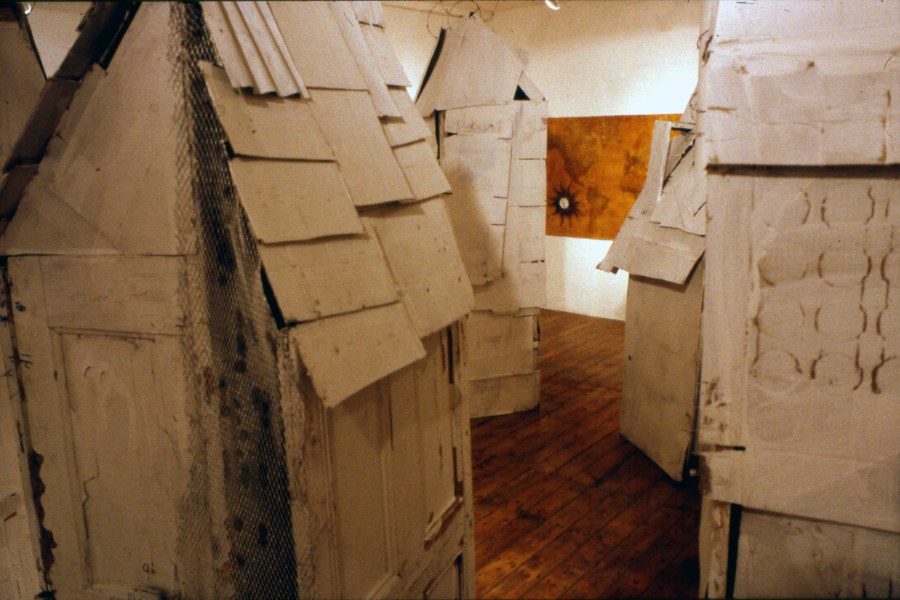
Crossroads 1986 In New British Sculpture, Air Gallery
Radios, Cardboard, Maps, Clocks, Barbed Wire.
x

///

x

“Technology is not neutral. We’re inside of what we make, and it’s inside of us.

We’re living in a world of connections —

and it matters which ones get made and unmade.” 

x

Donna Haraway (A Cyborg Manifesto. pp.149-181)

x

///

DIAGRA~1

Camera Projectors Diagram. 2005

///

x

“We have to see creation as tracing a path between impossibilities.” 

x

Gilles Deleuze  (Negotiations? & Essays Critical and Clinical. p x|viii)

x

///

10MarkIngham

“Ars Magna Lucis et Umbrae” 
Dilston Grove, Cafe Gallery Projects. 2008

///

x

“Art struggles with chaos but it does so in order to render it sensory….” (Watteau)

x

Gilles Deleuze and Felix Guattari.  (What is Philosophy? p205)

x

///

Doppelganger 3 Kings

Döppelganger: “We Three Kings…”  
2005  (Photographic Print 160 cm x 240 cm)

///

x

“Break a vase, and the love that reassembles the fragments is stronger than that love

which took its symmetry for granted when it was whole.” 

x

Derek Walcott (The Antilles: Fragments of Epic Memory. Nobel Lecture .1992)

x

///

Dr Mark Ingham 

View Mark Ingham's profile on LinkedIn

///

Twitter: (@ArsLucia)
Linkedin: (Mark Ingham)
Email: (markingham3@hotmail.com)

PDF CVMarkIngham2012CV

CV/Contact Page

← Back

Thank you for your response. ✨

[contact-field label="Name" type="name" required="1"/][contact-field label="Email" type="email" required="1"/][contact-field label="Website" type="url"/][contact-field label=’Comment’ type=’textarea’

///</script>

 

On an Ungrounded Earth

On an Ungrounded Earth, by Ben Woodard

20130613-214516.jpg

On an Ungrounded Earth, by Ben Woodard. Brooklyn, New York: Punctum Books. 118 pages. $12.00, paper.

In a 2011 interview conducted by Bookfriendzy, when asked about why he started his multi-disciplinary journal Collapse, Robin Mackay said (and I’m doing my best to transcribe here), “There were a number of problems that it was designed to address, one of which is the problem of where philosophy can exist outside of the academic environment—because of certain constraints of the academic environment—and the way in which the discipline of philosophy is conducted and constrained, and the conviction that philosophy happens everywhere, not just in philosophy departments.”

It might sound obvious—and a little silly—to think about it that way but the idea of philosophy being created and consumed outside of academia is a relatively recent innovation. Collapse is merely one of several increasingly visible venues publishing philosophical thought outside “philosophy departments,” many of which have hefty presences on the web. Certainly towering figures such as Nick Land, whose writings span a huge variety of subjects, and Quentin Meillassoux, whose landmark 2006 text, After Finitude, helped usher in a new era of “modern” philosophy, have had a major influence over a new generation of thinkers, writers and artists looking to construct arguments without, as Mackay put it, constraints.

As philosophy has moved away from outmoded schools and systems of thought, it’s now acceptable—if not outwardly fashionable—for writers to include examples of both “high” and “low” culture to illustrate and support their points. This leads us to Ben Woodard’s absolutely astounding On an Unground Earth, in which Woodard samples from a dizzying array of literature and media, all primarily centered around the disciplines of philosophy, science-fiction and horror. (Here’s a brief list of references: Deleuze and Guattari, Ray Brassier, Iain Hamilton Grant, Reza Negarestani, Jules Verne, Edgar Allan Poe, H.P. Lovecraft, Thomas Ligotti, Dune, Tremors, Star Trek, Star Wars, The Matrix series, The Technodrome from Teenage Mutant Ninja Turtles, Gears of War, Doom 3 and Dead Space—among many, many others.)

The subtitle of On an Ungrounded Earth is “Toward a New Geophilosophy.” As the back cover copy states, “In far too much continental philosophy, the Earth is a cold, dead place enlivened only by human thought—either as a thing to be exploited, or as an object of nostalgia.” One of Woodard’s contemporaries, Eugene Thacker, has written that there are three ways of interpreting the world as we know it: 1) the world-for-us, or the world in which we live; 2) the world-in-itself, or the inaccessible world which we then turn into the world-for us; and 3) the world-without-us, or the spectral and speculative world. In these terms then, Woodard’s Ungrounded Earth seeks to explore the relationship between human consciousness and the world-without-us.

Arranged in five sections—and despite its relatively brief page count—the text of On an Ungrounded Earth covers quite a bit of…well, ground. Abyssal and external “ungroundings,” giant worms, the panic of burial, the “dimensions” of hell, volcanic orifices—these are only a few of the topics explored. Because this is philosophy, and so much of the text builds off of ideas and concepts introduced in earlier passages, it’s difficult to pull any excerpts without disrupting Woodard’s meticulous terminology and contextualized language. Suffice it to say, that language is approachable and articulate. I wouldn’t exactly go so far as to call it accessible, but it’s certainly very readable. Overall, an excellent balance is struck between introducing new ideas, analyzing those ideas and explaining how everything relates back to the core idea of the book.

Part of that core is a deeply rooted fascination with the idea of philosophy itself, of “philosophically experiencing” the earth as we have come to understand it. On an Ungrounded Earth is one of an increasing number of texts that might be best described as speculative realism. Characterized by strong undercurrents of “anti-correlationism,” or, an outright rejection to Kant’s idea that we are limited to the correlation between thinking and being, speculative-realist texts are enjoying a good amount of attention in times of ecological imbalance and chaotic world trends. In 2013, a lot of us have spent the majority of our lives with the Internet. We have a constant supply of too much information—the anxiety of a shrinking world. We’ve long-ago accepted the idea of the universe expanding, seen a hundred movies depicting the destruction of our planet and helplessly witnessed the major religions of the world clash with one another again and again. Perhaps this is it. Perhaps whatever meaning there is to be found isn’t contained in the world-for-us. Perhaps, Woodard urges, the meaning we seek is right under our very feet—and has been for quite some time.

***

David Peak’s most recent book, Glowing in the Dark, was released by Aqueous Books in October, 2012. He is co-founder of Blue Square Press, an imprint of Mud Luscious Press, and lives in New York City.

///

Speculations

20130605-194320.jpg
Speculations IV, June 2013, ISBN: 978-0615797861

20130605-194341.jpg
If philosophy begins in wonder, then where does it end? What is its end? Aristotle said that while it begins in wondrous questioning, it ends with “the better state” of attaining answers, like an itch we get rid of with a good scratch or a childhood disease that, once gotten over, never returns. How depressing! Why can’t a good question continue being questionable or, in a more literal translation of the German, “question-worthy?” As Heidegger puts it, “philosophical questions are in principle never settled as if some day one could set them aside.” Couldn’t we learn from questions without trying to settle them, resolve ourselves to not resolving them? Couldn’t wisdom be found in reconciling ourselves to its perpetual love, and never its possession? Wittgenstein once wrote that “a philosophical problem has the form: ‘I don’t know my way about,’” which was the symptom of the deep confusion that constituted philosophy for him. But Heidegger loved wandering aimlessly in the woods, following Holzwege or paths that lead nowhere, stumbling onto dead-ends which could also be clearings.

–Lee Braver, “On Not Settling the Issue of Realism”

Download Speculations IV as a PDF.

Purchase print edition HERE.

–TABLE OF CONTENTS–

Editorial Introduction

PART I: REFLECTIONS

On Not Settling the Issue of Realism
Lee Braver

Politics and Speculative Realism
Levi R. Bryant

The Current State of Speculative Realism
Graham Harman

Weird Reading
Eileen A. Joy

A Very Dangerous Supplement: Speculative Realism, Academic Blogging, and the Future of Philosophy
Adam Kotsko

Speculative Realism: Interim Report with Just a Few Caveats
Christopher Norris

The Future of an Illusion
Jon Roffe

Realism and Representation: On the Ontological Turn
Daniel Sacilotto

PART II: PROPOSALS

“The World is an Egg”: Realism, Mathematics, and the Thresholds of Difference
Jeffrey A. Bell

Ontological Commitments
Manuel DeLanda

The Meaning of “Existence” and the Contingency of Sense
Markus Gabriel

Post-Deconstructive Realism: It’s About Time
Peter Gratton

Points of Forced Freedom: Eleven (More) Theses on Materialism
Adrian Johnston

Realism and the Infinite
Paul M. Livingston

How to Behave Like a Non-Philosopher, or, Speculative Versus Revisionary Metaphysics
John Mullarkey

“The Horror of Darkness”: Toward an Unhuman Phenomenology
Dylan Trigg

///

2013 HANNAH ARENDT PRIZE

2013 HANNAH ARENDT PRIZE

20130518-145635.jpg

Photograph of Hannah Arendt, NYC, 1944. Courtesy of the Estate of Fred Stein (fredstein.com)

THE HANNAH ARENDT PRIZE IN CRITICAL THEORY AND CREATIVE RESEARCH: CALL FOR SUBMISSIONS

Original Writing on Critical Theory and Creative Research

Award presented by the MA in Critical Theory and Creative Research Program
Entry submission: essay of 1,500 words or less

Application deadline: Friday, May 31, 2013

Theme: On Art and Disobedience; Or, What Is an Intervention?

Cash award: 5,000 USD

Winner announced by Saturday, August 31, 2013

Please note that essays over the limit will be disqualified.

The Hannah Arendt Prize in Critical Theory and Creative Research is an annual competition for those interested in the juncture of art and creative research and in the principles at the heart of the arts and humanities, including sense-based intelligence; the reality of singular, nonrepeatable phenomena; ethical vision; and consilience between inner and outer, nature and reason, thought and experience, subject and object, self and world.

Application for the prize is open to the general public. Download the PDF application and email the completed application and the essay (in a .doc or .pdf format) to ctcrprize@pnca.edu.

Explication of theme:

“To disobey in order to take action is the byword of all creative spirits. The history of human progress amounts to a series of Promethean acts. But autonomy is also attained in the daily workings of individual lives by means of many small Promethean disobediences, at once clever, well thought out, and patiently pursued, so subtle at times as to avoid punishment entirely. All that remains in such a case is an equivocal, diluted form of guilt. I would say that there is good reason to study the dynamics of disobedience, the spark behind all knowledge.”
Gaston Bachelard, Fragments of a Poetics of Fire

Intervention is an omnipresent if not ubiquitous word in contemporary discourse, but what forms does it take in the age of genetic engineering and real-time media? Is the concept a decoy or distraction in the face of futility? A cover or compensation for hopeless battles and set-ups? Is it simply working to slow down the Inevitable, a notion that in and of itself works as a major obstacle to critical thought and action? Or is it something more serious, more durable, and more dangerous? What is the relation of critique and intervention, theory and practice? And what role does art play in what Bachelard called “creative disobedience,” acts of Prometheanism “so subtle at times as to avoid punishment entirely”? Might art now comprise one of the last forms of political stealth, working in increasingly sophisticated time-based ways? What kinds of thought and action are powerful and compelling interventions today, whether one-off spectacles, sabots, monkey wrenches, sleepers, gummy bears, or Trojan Horses?

Along with Anne-Marie Oliver and Barry Sanders, Founding Co-Chairs, MA in Critical Theory and Creative Research, Pacific Northwest College of Art, the judges for 2013 include

Claire Bishop, Professor of Contemporary Art, Theory and Exhibition History, Graduate Center, The City University of New York

Judith Butler, Professor of Rhetoric and Comparative Literature, The University of California, Berkeley, and Hannah Arendt Professor of Philosophy, Europäische Universität für Interdisziplinäre Studien/EGS

Barbara Duden, Professor Emerita, Leibniz Universität Hannover

Julia Kristeva, Professor Emerita and Head of the École doctorale Langues, Littératures, Images, Université Paris Diderot, Paris 7, and recipient of the Hannah Arendt Award for Political Thought

Heike Kühn, Film Critic
Martha Rosler, Artist and contributor to the Hannah Arendt Denkraum (on the occasion of Hannah Arendt’s 100th birthday)

For information about last year’s competition, please see

http://www.artandeducation.net/announcement/the-hannah-arendt-prize-call-for-entries

///

THE TURING NORMALIZING MACHINE

THE TURING NORMALIZING MACHINE

by Yonatan Ben-Simhon and Mushon Zer-Aviv

An experiment in machine learning & algorithmic prejudice

20130515-171721.jpg

From: http://mushon.com/tnm/

In the 1930s British Mathematician Alan Turing studied normal numbers. During World War 2 he cracked the Nazi Enigma code, and then laid the foundations for computing and artificial intelligence. In the 1950s he was convicted of homosexuality and was chemically castrated. And in June 7th 1954, depressed by the anti-homosexuality medical treatment, and alienated by the society who deemed him abnormal, Alan Turing ate a cyanide laced apple.

In the following decades many of Turing’s ideas have materialized through the digital revolution, while many of them are still being researched. Inspired by Turing’s life and research we seek to finally crack the greatest enigma of all:

“Who is normal?”

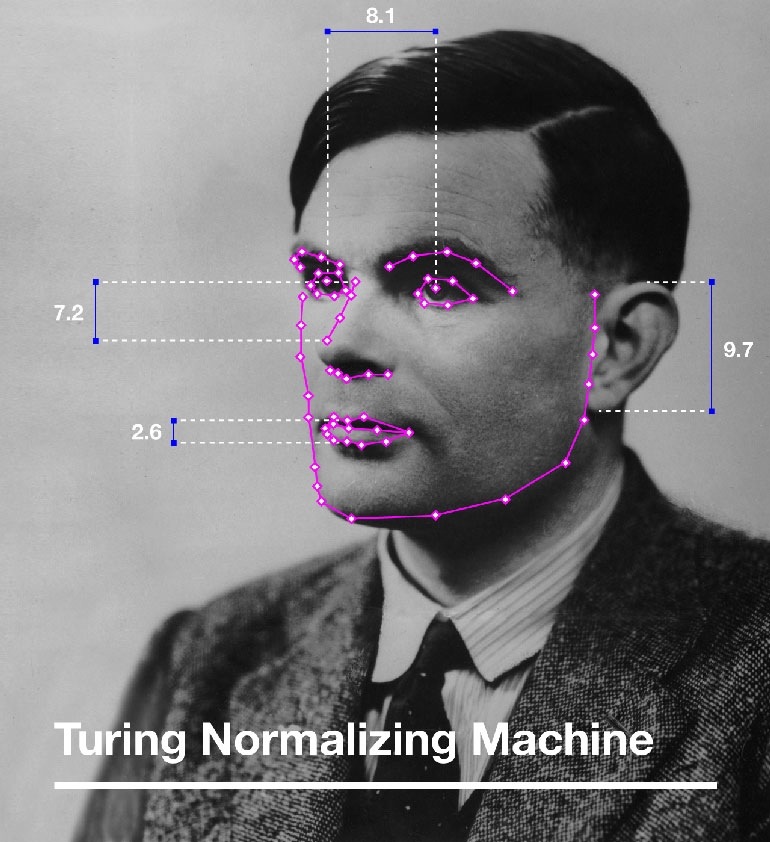
The Turing Normalizing Machine is an experimental research in machine-learning that identifies and analyzes the concept of social normalcy. Each participant is presented with a video line up of 4 previously recorded participants and is asked to point out the most normal-looking of the 4. The person selected is examined by the machine and is added to its algorithmically constructed image of normalcy. The kind participant’s video is then added as a new entry on the database.

As the database grows the Turing Normalizing Machine develops a more intricate model of normal-appearance, and moves us closer to our research goal: to once-and-for-all decode the mystery of what society deems “normal” and to automate the process for the advancement of science, commerce, security and society at large.

The abnormal,
while logically second,
is existentially first.

Georges Canguilhem, The Normal and the Pathological, 1966.

Conducted and presented as a scientific experiment TNM challenges the participants to consider the outrageous proposition of algorithmic prejudice. The responses range from fear and outrage to laughter and ridicule, and finally to the alarming realization that we are set on a path towards wide systemic prejudice ironically initiated by its victim, Turing.

by Yonatan Ben-Simhon and Mushon Zer-Aviv. [contact]

///