Screening Memories
Deniz Akca: Practice Re-constructed
Dr. Mark Ingham: 120 Days and Nights of STAGGERING + STAMMERING
Date: Wednesday 2nd May 2012, 2-4pm
Venue: Green Room, Chelsea College of Art and Design, Millbank
Present: Deniz Acka, Lee Campbell, Lorrice Douglas, Mark Ingham, Maria Kheirkah,Ope Lori, Elizabeth Manchester, Charlotte Webb
 |
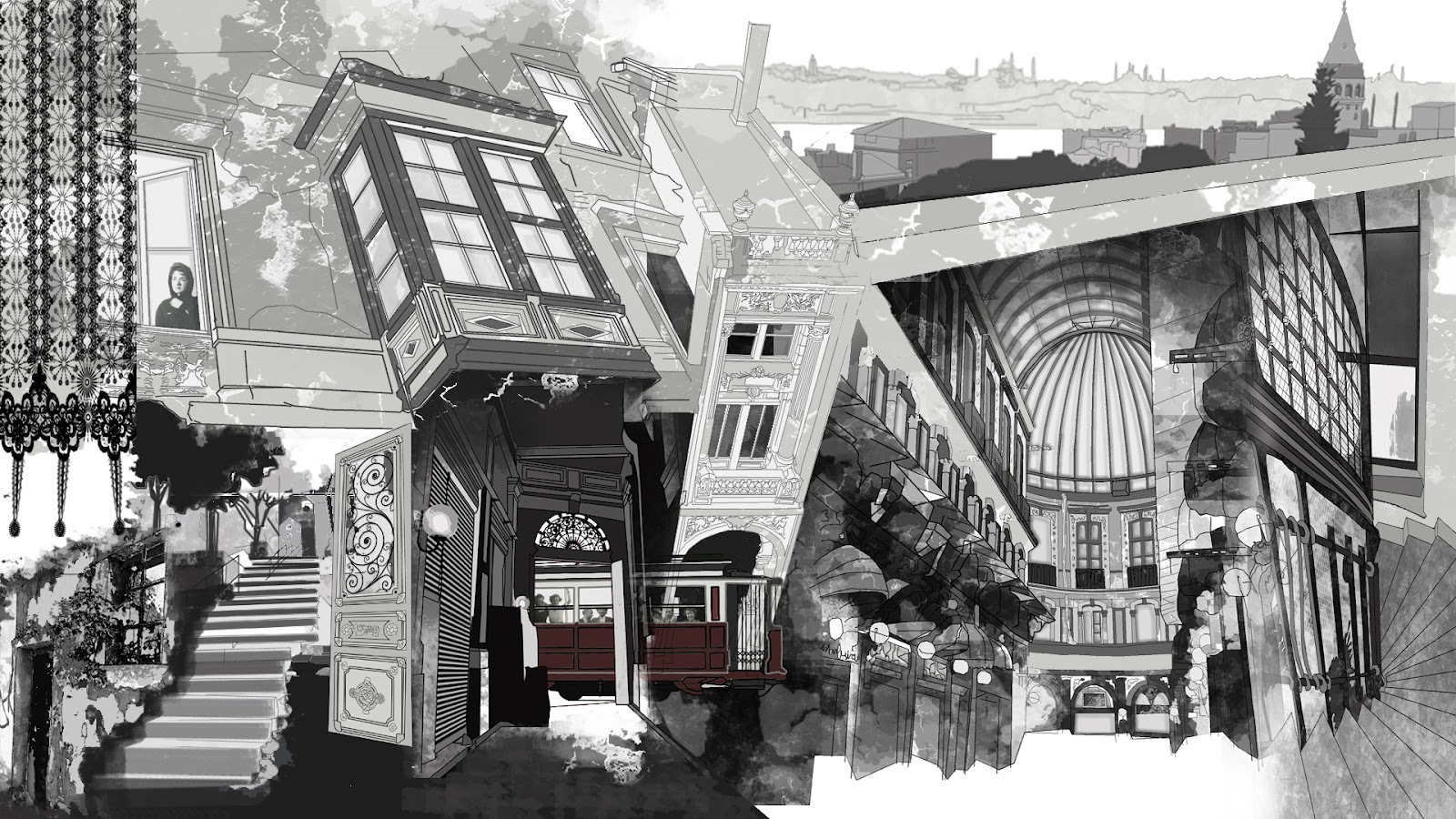
| Deniz Acka, Night Map 2012 |
Deniz Akca is a full-time research student at Chelsea College of Art and Design. Her practice-led research uses cinematic and animated film to map representations of female identity. She draws on film and architectural space as representations for cultural and sexual identity. Her case study is Istiklal Avenue, one of Istanbul’s most famous avenues, surrounded by majestic Ottoman buildings in a range of architectural styles. It is also the historic home to Istanbul’s most important cinemas. For the case study she investigates and analyses the photographic and filmic representations of women in this place. Her practice involves transforming her case study into animated image. For this presentation she will talk about how this particular urban space shaped the beginnings of her research practice during her initial training as an architect in Istanbul.
For the Practice Exchange Deniz introduced her research project which entails the mapping of female identity through Turkish film and architecture. The practice of mapping has been influenced by Atlas of Emotion: Journeys in Art, Architecture, and Film, by Giuliana Bruno as well as the psycho-geographical mapping present in the work of Peter Greenaway.
The site for Deniz’s research is Istiklal Avenue, a street in the historic Pera region of Istanbul. Deniz gave some historical background about the development of the regions of Pera & Gerata where Istiklal avenue resides, and which form the borders of her research. She described the development of Ottoman social relations to non-Muslim people living the area, and noted that different social and cultural conventions were played out amongst different social groups.
The foundations of Turkish cinema were formed close to Istiklal Avenue, and cinema was culturally significant in this area, with the first cinema opening there in 1938. Although Turkish cinema became prominent during the 1950s, Deniz is focusing on films from 1990 to the present. She showed a key photograph from the 1970s, depicting a group of actresses, actors and directors who took to the streets to celebrate the birth of Turkish cinema.
Deniz is particularly interested in the representation of Istiklal Avenue in the 1993 film Whistle If You Come Back by Orhan Oğuz, which she first saw when she was 9 years old.Whistle if you come back is about the painful lives and struggles of two nameless protagonists – a transvestite and a dwarf who are referred to as ‘This and That’. Scenes of exchange between them are shot inside a flat on Istiklal Avenue, the landlady of which is ‘Madame Lena’, a rich Greek lady from a non-Muslim community. Madame Lena’s character is important with regard to the representation of the female identity of Istiklal Avenue. She is isolated from society in the film, and in a real-life reflection of this, Deniz noted that the actresses name was never listed in the cast list of the film. The rights of film belong to ministry of culture of Turkey.
Madame Lena’s identity is unexplored in the film, which provided a space for Deniz to interpret her identity imaginatively in her first animation, a reconstruction of the interior of Madame Lena’s flat. Deniz thought of Madame Lena’s bedroom as a museum where memories are collected. The architectural space and her objects are used as a representation of her cultural identity.
Films provide the main source material for her research, but Deniz also goes to Istanbul as much as possible to gather images from second-hand book shops and to take her own photographs. She noted that this is not archival research.
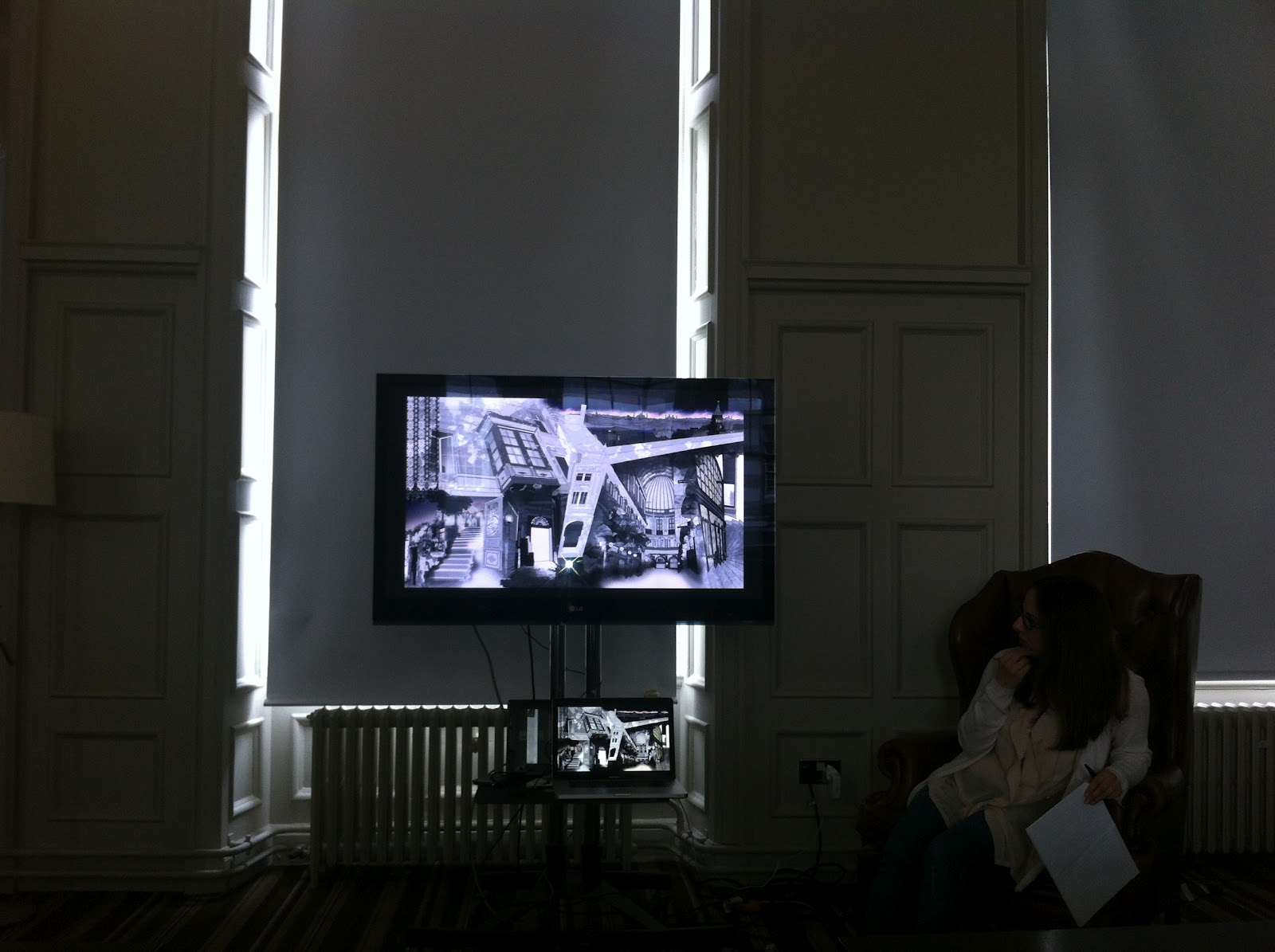
Deniz showed her latest animation, ‘Night Map’, which she referred to as documentation of ‘memory spaces’ in Istiklal Avenue. Certain details of the architecture were reconstructed from Deniz’s own materials and photographic collections. The animation depicts a fragmented architectural space in which the streets’ inhabitants appear and disappear. There is an evocative sound track which comprises sounds of the comings and goings of people and traffic on Istiklal Avenue.
DISCUSSION
In relation to the Night Map work, Mark was reminded of Deleuze’s concept of the crystal image because of how it deals with time and space. As in Deniz’s animation, in the crystal image time, space and sound become something we don’t expect…
Maria noted that, going back and forth from Iran, she is always struck by sounds and how different they are from sounds in the UK. She commented that the sound performs an important function in Deniz’s work.
Maria asked if there a sense in which Deniz’s work represents her own feelings of isolation from Turkey. Deniz doesn’t see herself as an outsider, having lived in Istanbul from 2001 – 2007. She described her presence there in the past as an almost disappeared architectural layer – now she is here in the UK, removed from the city, she can look at the city as a research object.
Maria also noted that there seemed to be an element of voyeurism or exoticisation present in the work, though it was noted that it might not be possible to avoid an element of voyeurism.
There was a discussion of the question of absence in Deniz’s work – in her first animation she wanted to refer to the absence of the non-Muslim women in Istiklal Avenue, and the absence of Madame Lena’s character in the film. In the later work, images of women are used. There was a discussion about how images of women might be utilised by Deniz and what the potential problems are with this – particularly ethical issues surrounding the use of found images of women whose relatives may still be alive. Charlotte noted that the floating ghostly quality of the figures in the Night Map work underlined this sense of disembodiment – of separation from the representation of women from the reality of their lives?
 |
| Dr. Mark Ingham, Marilyn Henry and Me 1956-2011 |
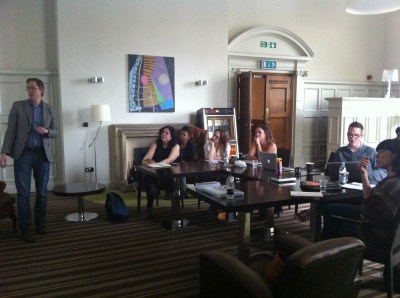
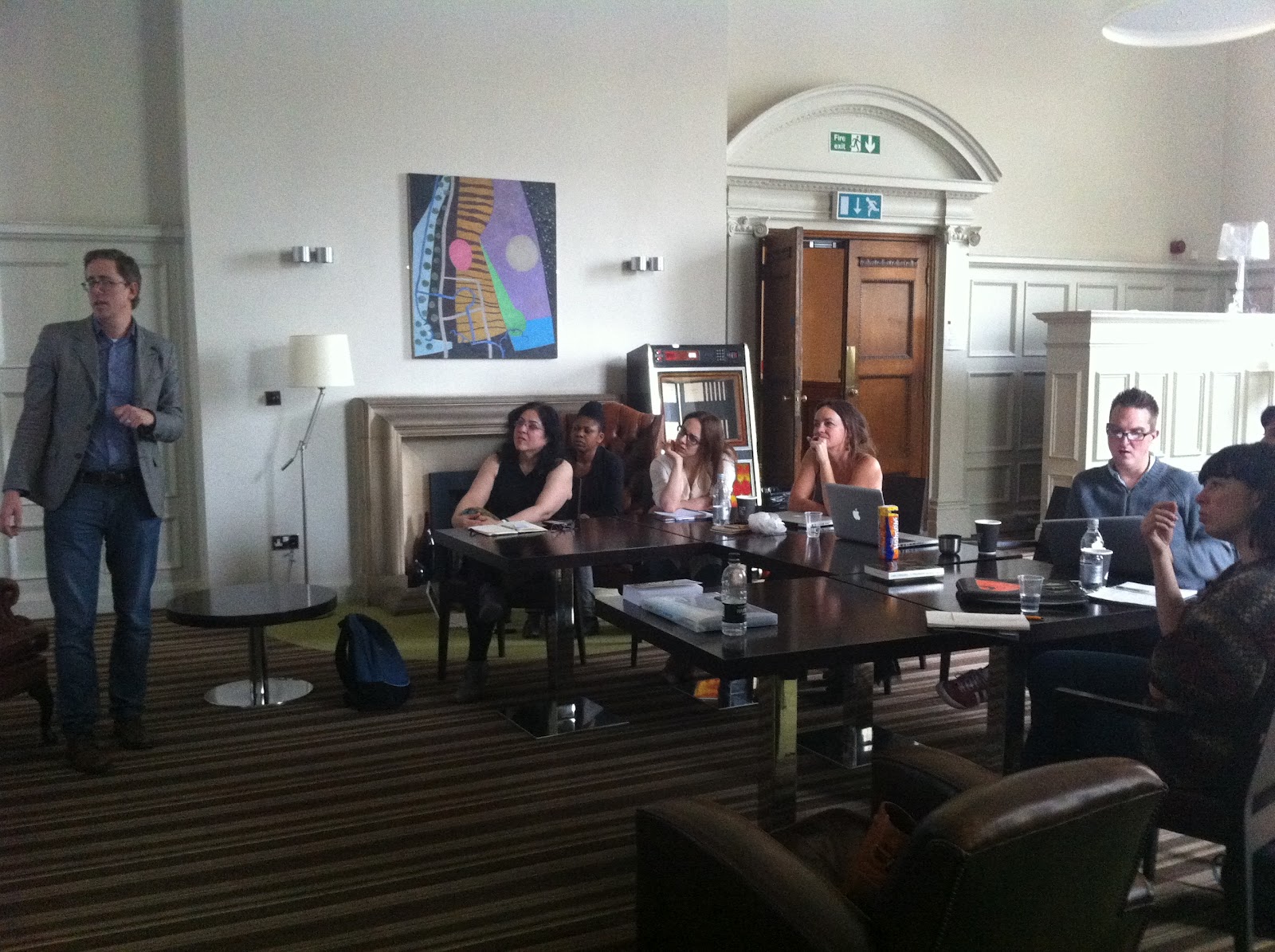
Dr. Mark Ingham is PhD Director of Studies/Supervisor at Wimbledon College of Art, and Principal Lecturer (Masters Programme Leader) in the Communication Media for Design Department at the School of Architecture & Construction, University of Greenwich. For the Practice Exchange, Mark will begin by presenting a short film:
“The young man at the beginning of Andrei Tarkovsky’s ‘The Mirror’ stammers and stutters, and then learns not to. My grandmother, Rose-Marie, staggers out of The China Hall Public House, The White Horse Tavern, The Crystal Tavern, The Eagle and never learns. In the icy wastes of the French Alps she dives into freezing lakes. Followed by my grandfather, without a St. Bernard dog for company. ‘Ice, No Brandy’. The very, very, late night Troy Bar in Soho always clings. However far I try and get away from ‘Grey Gardens’ it still tugs me back to ‘Tea for Two’. ‘Just tea for two and two for tea Just me for you Just tea for two and two for tea Just me for you.’ Our lives are smeared throughout the world, recalled through disparate, dissolute, fragmentary images, sounds and memories. This becoming can be a start of a conversation.”
For the Practice Exchange, Mark began by showing a slideshow of images in order to introduce himself to the audience. This comprised images of his own work in relation to fragments of text from A Thousand Plateaus, by Gilles Deleuze and Felix Guattari. Mark became enamoured with Deleuze & Guattari when doing his PhD at Goldsmiths. In his work, he is trying to unravel the idea of the rhizome. For TPE he wanted to unpick the first passage in A Thousand Plateaus where the rhizome is described.
One of the things that appeals to Mark about Deleuze is that he tries to question what thinking is. (Deleuze’s PhD included a chapter called ‘The Image of Thought’). Deleuze and Guattari want to go against the idea that knowledge is rooted or fixed. They want everything to be connected – they don’t want us to be separated – Mark is attempting to reflect on whether he can or has become rhizomatic in his work. It was noted that an attempt to engage an audience by way of metaphor (such as the rhizome) is problematic, because it’s easy to start focusing on the images being which can, paradoxically, fix or obstruct the broader conceptual terrain…
Mark showed a series of early works from his BA and MA ranging from large scale wooden structures, to an installation of hanging chairs which he saw as ghosts, to a bin full of garlic, shown at Camberwell college, which made a gallery visitor vomit several times. He mentioned that at this time, he took up contemporary ballet.
He talked about a Henry Moore fellowship undertaken from 1985-1986, during which he was putting objects in trees, and described a desire to escape his own ‘artschoolness’. He wanted to avoid making things that looked too conspicuously like ‘art’, and to resist art’s imperative for signification.
In a later series of work, he started to trace his genealogy through his grandfather’s slide collection, tracing over many overlayered slides to create densely layered drawings.
DISCUSSION
Mark said he feels trapped by making art – though this is not necessarily a bad thing, as making art can be truly liberating. There was a connection between Deleuze’s desire to resist signification and Mark’s desire to resist the conventions of art production.
Deniz was interested that Mark talked about education – she is from an architectural background, and expected that art would be a ‘free space’! That it is seen as so bound by conventions and aesthetic boundaries was a surprise to her.
Charlotte felt that her life as an artist is also characterised by the feeling of being trapped – again, she does not feel this is necessarily completely negative, but rather provides something to push away from in developing her practice.
There was significant discussion of the computer generated voiceover in the film, which is created using a read out loud text to speech tool in Adobe Acrobat. The voice had a quality of chanting or incantation, and it was sometimes difficult or impossible to understand what was being said. Mark said that he wanted to avoid having a conventional narrative, using his own voice. There was a simultaneous desire to articulate a practice and be voiceless…
Lorrice was struck by the performative nature of the work, and saw Mark’s practice as trying to perform Deleuze, or embody a Deleuzian approach.
Charlotte enjoyed the fact that the temporal status of 120 days and nights of STAGGERING and STAMMERING was difficult to pin down – was it documentation of a show, was it a proposal for a show, did it look into the past or future? There were seen to be similarities between Mark and Deniz’s work in this regard.Elizabeth liked the fact that in the first part of the presentation, there were some linguistic slippages between the texts on the screen and the way Mark read them – this was pertinent to the idea of stammering…



 Mark Ingham