Fantastic!
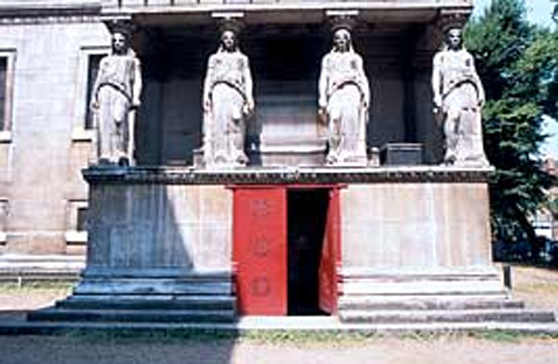
The Catacombs under St. Pancras Church, Euston Road, London WC1.
Thursday 26th June – Sunday 29th June 2003
Curated by Dolly Thompsett.
///
///

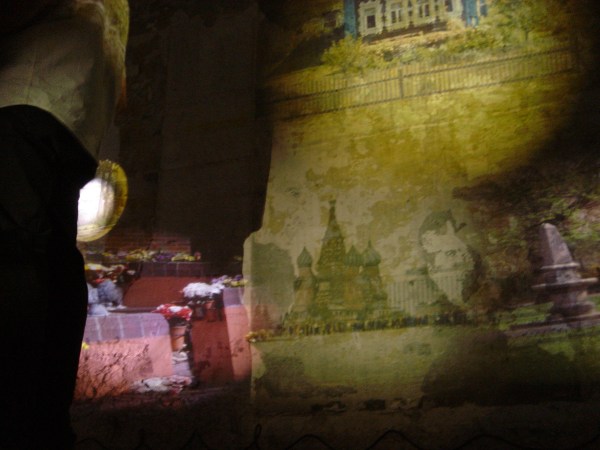
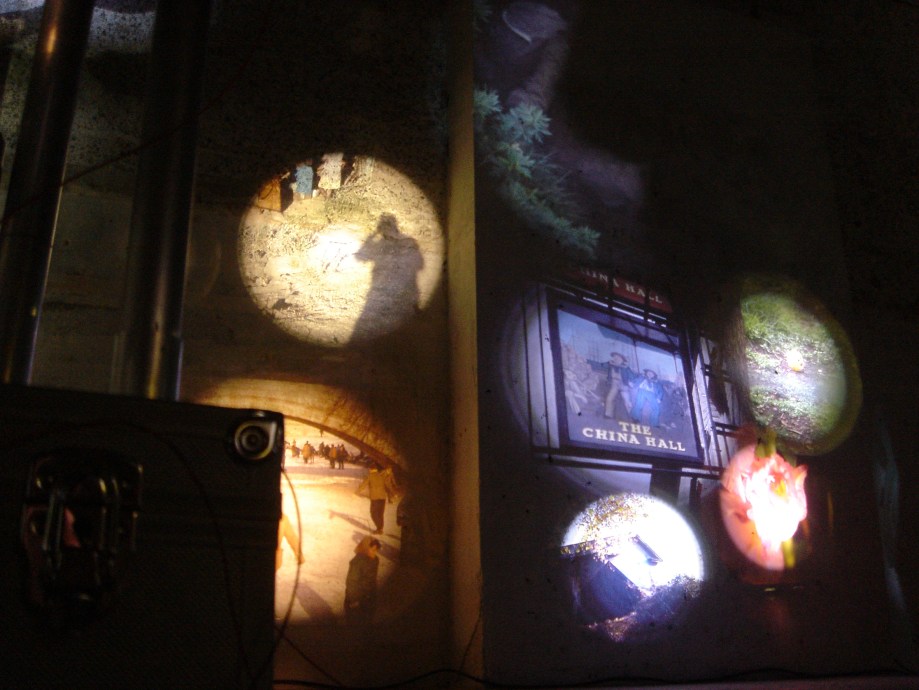
Mark Ingham: “Its Good For You Cold“ 2005. SLR Camera, Slide, Torch.
///
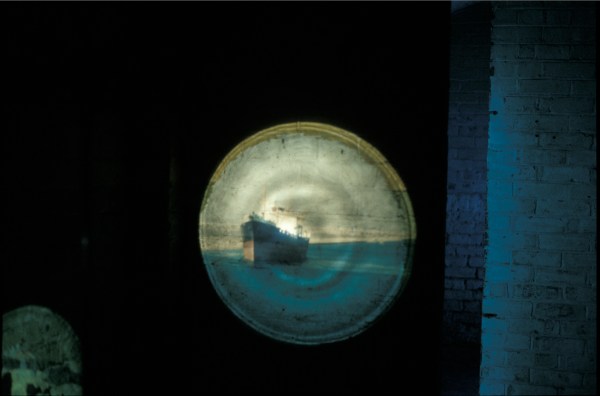
Mark Ingham: ‘Suez with RMJI’ 2005. SLR Camera, Slide, Torch.
///
There are three possible accounts that would serve this show not quite equally well.
First, imagine lots of Ken Russells. Russells connected by being at college together, being youngish, being already slightly successful. Russells acutely, fantastically sensitive to serious climactic changes, changes that effect the reception of work. Imagine our genteel Russells ushering in an equal number of head-down shambling dry Oliver Reeds for ladylike recuperation. Imagine all those strained director’s chairs.
Alternatively, imagine that it was possible to dissociate a part of experience – as a part characteristic against a whole. Doesn’t something fantastic necessarily emerge from an indeterminate background? Isn’t there always the risk that the psychological and poetic, dramatic and pedagogic components of a fantastic scenario are mistaken so that a foreground (where the proposed action is) obscures the shady workings of an interesting background? In Macbeth for instance, the shifting Dunsinane woods, stripped of symbolic, dramatic function – relevance – against a large significant backdrop of intrigue, would hardly seriously support the play as an object of interest.
Of course it’s a species of dramatic short-termism to isolate or regulate a moment of realisation, the optical point of the resolution of an effect as being an effect. A show like Fantastic! might, through integrating or itemising or casting multiple positions, multiple effects – spotlight and suspend dramatic resolutions.
Thirdly, imagine a complex arrangement between a varied group of artists and a curator where what would be required would be a degree of irresolution directed by experience. The type of name you might name something like this would be something allusive – it would come slowly tripping-off the tongue with an alien coating of protective spittle or glycerate. It would have an ! And it would be indeterminately a spontaneous or considered (but quick) value-judgement; suggestive or flatteningly literal. But there would be connotations of serious, archetypal historic categorisation – The Fantastic – and there would be oppositional associations even directed towards the technical sublime; as there would be knowingly, absolutely contemporary invocations of the aesthetic.
The third option accommodates the first two in a zone of enriched darkness improbably lit by individual works underground where Dolly Thompsettˆs show featuring Alice Anderson, Heike Cavallo, Ole Hagen, Ahn Sung Hee, Mark Ingham, Liane Lang, Dee Meaden, Salomé Voegelin and herself will be, for a short time, Fantastic!
Matthew Arnatt 2003
///
///
“The viewer of a Fantastic image hesitates, wonders whether what he is seeing is real, if what he is confronted with is indeed reality, or whether it is no more than an illusion. The ambiguity is sustained to the end of the encounter: reality or magic? Truth or illusion? Which brings us to the very heart of the Fantastic. In a world which is indeed our world, the one we know and recognise, we perceive an event which cannot be explained by the laws of this same familiar world. The person who sees the event must opt for one of two possible solutions: either he is a victim of an illusion of the senses – or else the event has indeed taken place, in which case reality is controlled by laws unknown to us. The Fantastic occupies the duration of this uncertainty. Once we choose a rational explanation or a supernatural one, we emerge from the Fantastic and enter the Uncanny or the Marvellous. The Fantastic is that hesitation experienced by a person who knows only the laws of nature, confronting an apparently supernatural event. ‘I nearly reached the point of believing,’ that is the formula which sums up the spirit of the Fantastic. Either total faith or total incredulity would lead us beyond the fantastic: it is hesitation which sustains its life. ” (Misquote, Todorov, “The Fantastic: A Structural Approach”)
Fantastic! was curated by Dolly Thompsett.
///
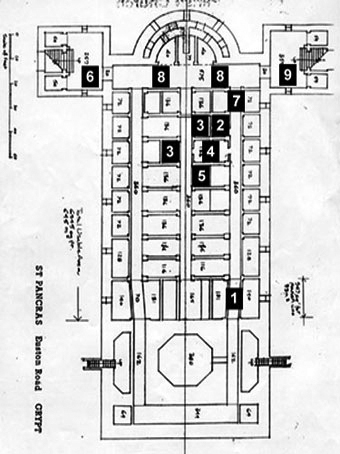
Artists in FANTASTIC! from a website created by Tom Ingham at www.suchlovelypictures.co.uk
1 Alice Anderson
2 Heike Cavallo
3 Ole Hagen
4 Mark Ingham
5 Liane Lang
6 Dee Meaden
7 Ahn Sung Hee
8 Dolly Thompsett
Salomé Voegelin
///
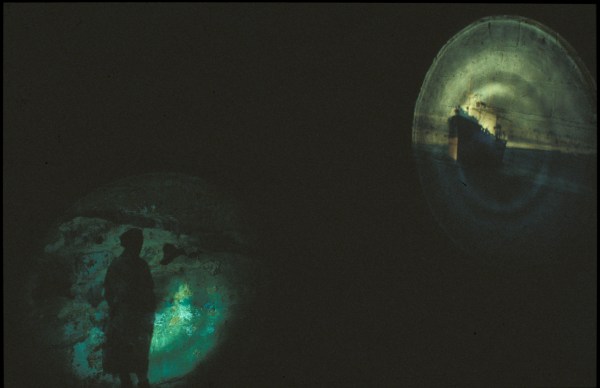
Mark Ingham: ‘Suez with RMJI’ 2005. SLR Camera, Slide, Torch.
///




 Mark Ingham