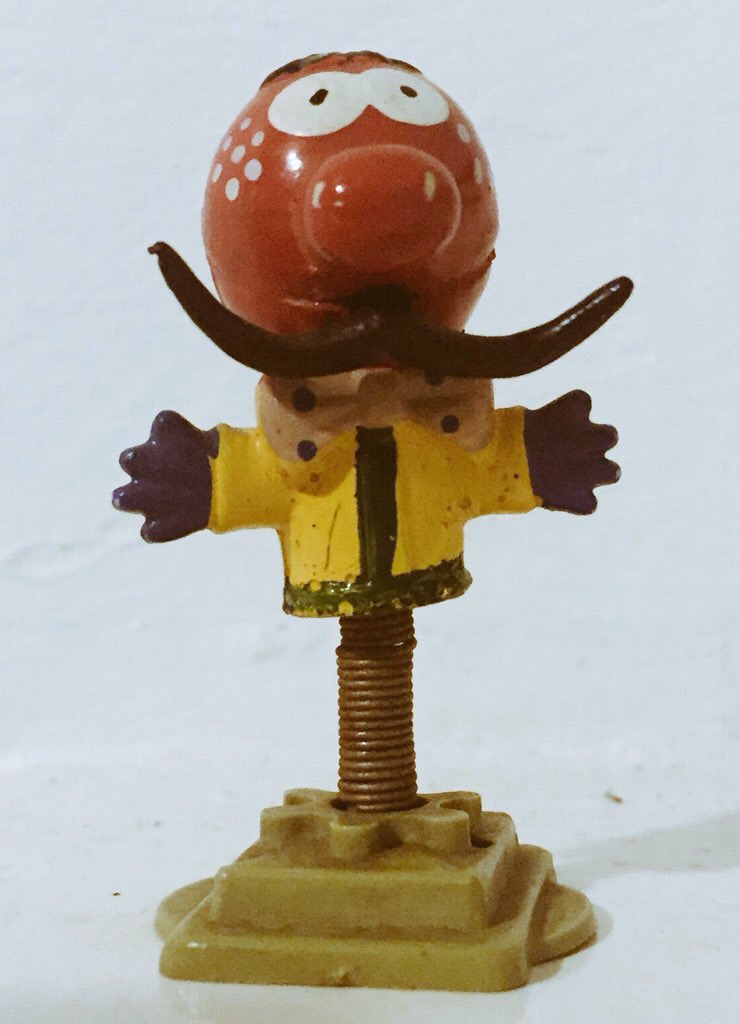
BOING!
Designs on eLearning conference
NYC New School
21 – 22 September 2016
“Mark, How did you know any thing before the Internet existed?”
21 September 11:30 Room 3
Presenter: Mark Ingham
Institution: London College of Communication, University of the Arts London
Theme: Anxiety and Security in the Curriculum
Format: workshop
Description
The During a debate about the reasons why conspicuous theories are perpetuated and are still prevalent today a first year BA art and design student with a puzzled mixture of bewilderment, arrogance, anxiety and concern asked me how my pre digital generation knew anything before the Internet existed.
This group of very articulate students seemed both highly sceptical of any knowledge from any source yet wanted to believe in unfounded and contentious conspiracy theories. They gave the same credence to a highly qualified structural engineer as a basement blogger. Both sources were seen as ‘opinions’ and both as equally legitimate.Digging deeper into this it seemed that they thought the older generations were too accepting of ‘authority’ and their internet savvy generation were just being more open and more thoughtful.
This worshop will interrogate this paradox of accepting what is on the Internet as all the same yet at the same time distrusting well researched information based on prior experiments or prior knowledge. It will also attempt to answer the question, ‘How did we know anything before the Internet?’
Timetable
Setting up the debate, ‘Why do conspiracy theories still exist and what role has the Internet palates in perpetuating them’. The participants will be divided into two opposing debating groups each with an conflicting statement. They will then debate each other’s ideas. There will then be a plenary session of 20 minutes to discuss the ideas from the debate.
Interaction
This will be a very hands on session where I will recreate the debate format of the session I had with students. It will become a debating chamber.
Takeaway
A more nuanced understanding of the reasons why students are anxious and yet arrogant about the supply of knowledge in our digital age.
Outcomes
The outcomes of this session will be fed back into UALs digital pedagogical strategy through our Learning and Teaching days. It will also be disseminated on the LCC School of Design Contextual and Theorectical course and unit blogs.
REGISTER NOW
PARALLEL SESSIONS IN ROOM 3
“Mark, How did you know any thing before the Internet existed?”
+
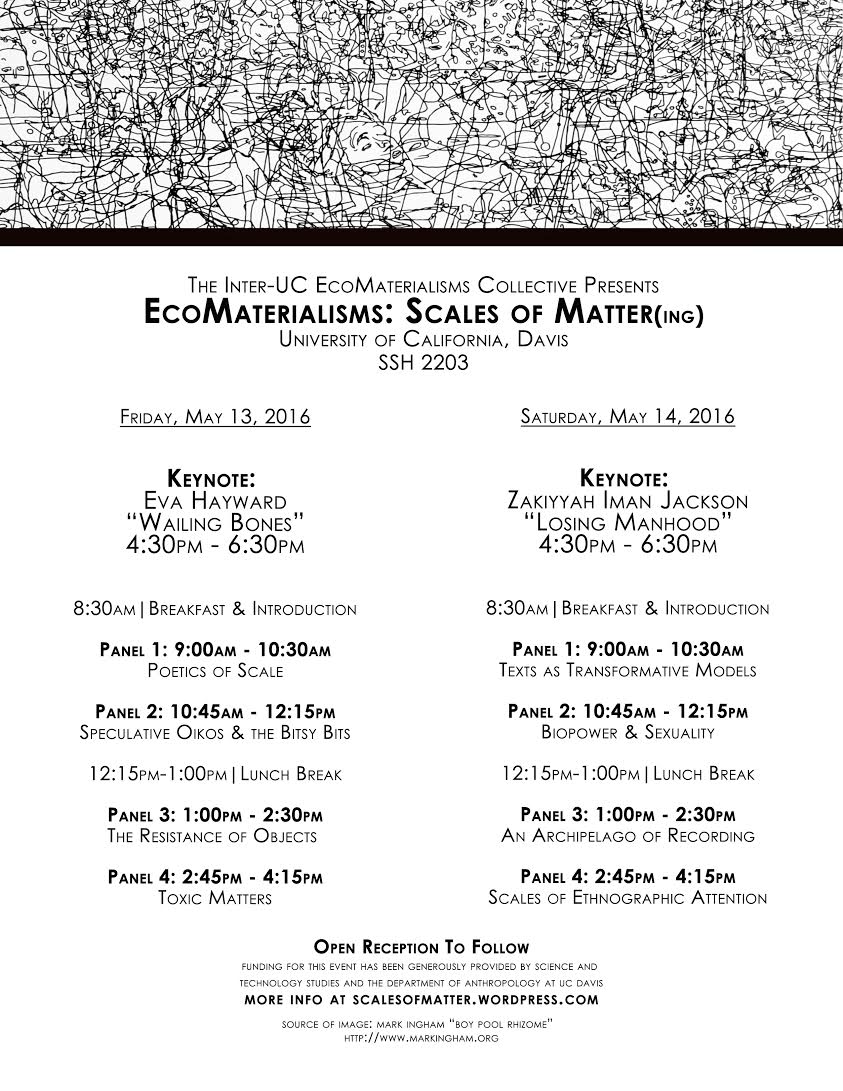
Flyer for the conference “EcoMaterialisms: Scales of Matter(ing)” at UC Davis
https://scalesofmatter.wordpress.com/
by JG Ballard (q
Can I offer a dissenting opinion? There seems to be a profound need everywhere to admire Star Wars, and a resentment of any response other than loving affection. Star Wars, written and directed by George Lucas, is engaging, brilliantly designed, acted with real charm, full of verve and visual ingenuity. It’s also totally unoriginal, feebly plotted, instantly forgettable and an acoustic nightmare – the electronic sound-wall wrapped around the audience is so over-amplified that every footfall sounds like Krakatoa.
In that case, why all the fuss? And what does the amazing success of Star Wars indicate, for good or ill, about the future of s-f cinema? Although slightly biased, I firmly believe that science fiction is the true literature of the twentieth century, and probably the last literary form to exist before the death of the written word and the domination of the visual image. S-f has been one of the few forms of modern fiction explicitly concerned with change – social, technological and environmental – and certainly the only fiction to invent society’s myths, dreams and utopias. Why, then, has it translated so uneasily into the cinema? Unlike the western, which long ago took over the literary form and now exists in its own right, the s-f film has never really been more than an offshoot of its literary precursor, which to date has provided all the ideas, themes and inventiveness. S-f cinema has been notoriously prone to cycles of exploitation and neglect, unsatisfactory mergings with horror films, thrillers, environmental and disaster movies.
The most popular form of s-f – space fiction – has been the least successful of all cinematically, until 2001 and Star Wars, for the obvious reason that the special effects available were hopelessly inadequate. Surprisingly, s-f is one of the most literary forms of all fiction, and the best s-f films – Them!, Dr Cyclops, The Incredible Shrinking Man, Alphaville, Last Year in Marienbad (not a capricious choice, its themes are time, space and identity, s-f’s triple pillars), Dr Strangelove, The Invasion of the Body Snatchers, Barbarella and Solaris – and the brave failures such as The Thing, Seconds and The Man who Fell to Earth – have all made use of comparatively modest special effects and relied on strongly imaginative ideas, and on ingenuity, wit and fantasy.
With Star Wars the pendulum seems to be swinging the other way, towards huge but empty spectacles where special effects – like the brilliantly designed space vehicles and their interiors in both Star Wars and 2001 – preside over derivative ideas and unoriginal plots, as in some massively financed stage musical where the sets and costumes are lavish but there are no tunes. I can’t help feeling that in both these films the spectacular sets are the real subject matter, and that original and imaginative ideas – until now science fiction’s chief claim to fame – are regarded by their makers as secondary, unimportant and even, possibly, distracting.
Star Wars in particular seems designed to appeal to that huge untapped audience of people who have never read or been particularly interested in s-f but have absorbed its superficial ideas – space ships, ray guns, blue corridors, the future as anything with a fin on it – from comic strips, TV shows like Star Trek and Thunderbirds, and the iconography of mass merchandising.
The visual ideas in Star Wars are ingenious and entertaining.Ironically it’s only now that the technology of the cinema is sufficiently advanced to represent an advanced technology in decline. I liked the super-technologies already beginning to rust around the edges, the pirate starship like an old tramp steamer, the dented robots with IQs higher than Einstein’s which resembled beat-up De Sotos in Athens or Havana with half a million miles on the clock. I liked the way large sections of the action were seen through computerized head-up displays which provided information about closing speeds and impact velocities that makes everyone in the audience feel like a Phantom Pilot on a Hanoi bombing run.
In passing, the reference to Vietnam isn’t undeserved – the slaughter in Star Wars, quite apart from the destruction of an entire planet, is unrelieved for two hours, and at times stacks the corpses halfway up the screen. Losing track of this huge bodycount, I thought at first that the film might be some weird, unintentional parable of the US involvement with Vietnam, with the plucky hero from the backward planet and his scratch force of reject robots and gook-like extraterrestrials fighting bravely against the evil and all-destructive super-technology of the Galactic Empire. Whatever the truth, it’s strange that the film gets a U certificate – two hours of Star Wars must be one of the most efficient means of weaning your pre-teen child from any fear of, or sensitivity towards, the deaths of others.
All the same, as a technological pantomime Star Wars makes a certain amount of sense. There’s the good fairy, Alec Guinness, with his laser-wand and a smooth line in morally uplifting chat; the pantomime dame/wicked witch, the Dark Lord Darth Vader, with black Nazi helmet, leather face-mask and computerized surgical truss; the principle boy, the apparently masculine robot R2D2 who in fact conceals a coded holographic image of Princess Leia, which he now and then projects like a Palladium Dick Whittington flashing her thighs.
However, George Lucas has gone badly astray with his supporting cast – what looks like an attempted tour de force, the parade of extraterrestrials in the frontier-planet saloon, comes on hilariously like the Muppet Show, with shaggy monsters growling and rolling their eyeballs. I almost expected Kermit and Miss Piggy to swoop in and introduce Bruce Forsyth.
What is missing in all this is any hard imaginative core. Star Wars is the first totally unserious s-f film. Even a bad episode of Star Trek or Dr Who has the grain of an original idea, and the vast interplanetary and technological perspectives of 2001 were at least put to the service of a steadily expanding cosmic vision. The most one can hope, I think, is that the technical expertise now exists to make a really great s-f film. Star Wars, in this sense, is a huge test-card, a demonstration film of s-f movie possibilities.
20th Century-Fox’s advance publicity describes the modern motion picture as ‘the most magnificent toy ever invented for grown men to play with and express their fantasies’ – presumably with Lucas’s approval, and Star Wars may well be more prophetic than I give it credit for. In many ways it is the ultimate home movie, in which Lucas goes back into his toy cupboard and plays with all his boyhood fantasies, fitting together a collection of stuffed toys, video games and plastic spaceships into this ten-year-old’s extravaganza, back to the days, as he himself says, when he ‘dreamed about running away and having adventures that no one else has ever had’.
JG Ballard
Time Out
1977
From: http://spager.home.xs4all.nl/Scorn/toot/sturr.htm?utm_content=bufferfccfc&utm_medium=social&utm_source=facebook.com&utm_campaign=buffer

Cover page from Imogen Armstrong’s MSc from SAOS
Figure 1: Title page ‘BoyPoolRhizome’
BoyPoolRhizome (1999-2003) Black marker pen and pencil on paper. 150cm x
100cm. (Collection of the artist) by Mark Ingham
URL:https://markingham.org/stories/becoming-rhizomatic/boypoolrhizome-2/
 Mark Ingham