A thoughtful article by ORIT GAT at http://rhizome.org/
Projected Projects: Slides, PowerPoints, Nostalgia, and a Sense of Belonging
The discipline of art history used to have a sound, the click and growl of the slide projector. It had a look, too, that was composed of darkened lecture halls and sometimes-blurry images of a unified size.
Kodak stopped manufacturing 35mm slide projectors in 2004, a decision in line with the company’s current focus on digital photography. The website dedicated to Kodak slide projectors has been archived as a frozen version, current as of November 2004. Soon enough, that website would seem as old fashioned as the famous poster celebrating the invention of the carousel slide projector.
ABC’s “Mad Men” credited Don Draper, the head copywriter at the ad firm the show focuses on, as the inventor of the term “the carousel,” for Kodak’s then-cutting edge technology. In the scene where he pitches the term to Kodak, he states, “The Greeks call it nostalgia. […] It’s a twinge in your heart, far more powerful than memory alone.”

///
The fact that slide projectors are now becoming a technology on the verge of death invokes a new feeling of nostalgia. Slide projectors were commonly used for varied purposes, from the family slideshow through the business meeting display, and up to illustrated lectures. These devices were commonplace and their aesthetic, sound, and use bring up familiarity and a certain tradition.
In 2005, shortly after Kodak’s announcement that it will no longer produce slide projectors, curator Darsie Alexander at the Baltimore Museum of Art organized the exhibition “Slideshow.” Featuring nineteen works made between the 1960s and the early 2000s by artists such as Robert Smithson, Dennis Oppenheim, Ceal Floyer, and Dan Graham, “Slideshow” celebrated the medium itself. It was presented in a series of darkened rooms where the only light came from the slide projectors and the sound of the changing slides echoed throughout.

Robert Smithson, Hotel Palenque, 1969, 35mm slide projection (detail).
///
35mm slides have a number of built-in characteristics that appeal to artists. First and foremost, they are a high resolution color image, which, in the 1960s, was a refreshing change from the dominance of black and white photography. Secondly, the slide projectors have an inherent sense of narrative built into them. Be it an 80-slide or 140-slide tray, and whatever number of seconds it is set to automatically change slides after, the projector presents a story in a certain time frame and a specific number of images.
What was appealing for artists in the 35mm slides was slowly disappearing in the projection technologies that followed it—first, the overhead projector, and more so, PowerPoint. The overhead projector using transparencies is still quite frequently used in contemporary art. PowerPoint, however, is different.
Since its introduction in the early 1980s, PowerPoint has become the tool of corporate culture. It drove the overhead projector out of the boardroom quite quickly, but it also became a trope of contemporary communications. According to Microsoft, thirty million PowerPoint presentations are given every day, almost all of them featuring the silhouette stick figure that stands beneath a question mark. PowerPoint was not the natural digitized version of the slide or the overhead projector. It was not the Mr. Coffee to the plastic funnel coffee filter holder. PowerPoint comes with a culture of organizing information—in bulletproof points, using a series of templates, and with AutoContent complete into the program.

Ofri Cnaani, Moviemakers (detail), 2010, overhead projection, handmade transparencies.
///

Ceal Floyer, Overhead Projection, 2006.
///
The use and value of PowerPoint has been widely discussed. A doubt was cast upon its efficiency in Edward R. Tufte’s famous article “The Cognitive Style of PowerPoint,” where he coined the (surprisingly commonplace) term “PowerPoint phluff” to describe inessential visuals in PowerPoint presentations (puzzled man silhouette included). The use of PowerPoint in the private and corporate realms was slighted in “Absolute PowerPoint” in The New Yorker in 2001, where the writer Ian Parker spells out how “PowerPoint is a software you impose on other people.”
Most art history classes are now taught using PowerPoint. We are getting more and more accustomed to viewing art digitally and online, insomuch that Google used its Street View technology to also make available virtual visits to museums across the world as part of Google Art Project. And the performative aspect of the PowerPoint is utilized in Pecha Kucha and Slideluck Potshow events. Maybe it is time that we throw thinking about the slideshow as a curatorial project into the mix. What worked for Baltimore Art Museum’s “Slideshow” will not work with PowerPoint, whose physical characteristics are quite different.
///
PowerPoint slides projected on the wall are heavy files in a low resolution, especially when compared to paper or 35mm slides. The capabilities of the human eye-brain system are much larger than what PowerPoint can offer, thereby making it harder to focus solely on the slides themselves. Notwithstanding projects like UC Berkeley Pacific Film Archive’s “PowerPoint to the People,” a competition of PowerPoint artworks (surveyed on Wired here) and Peter Norvig’s Gettysburg PowerPoint Presentation, which has been linked to and mentioned countless times, a PowerPoint presentation still needs to be activated. It is a performative medium. Not surprisingly, many of the examples I could find of artists using PowerPoint are as part of performances. In his recent work, shown at Performa and SFMOMA, The Boy Who Cried Wolf, Simon Fujiwara carries a remote control for a PowerPoint presentation that he uses as part of the performance almost throughout the work. Does this differ from giving a lecture while using PowerPoint? David Byrne gave a series of lectures titled “I [heart] PowerPoint” at museums and universities across the country. He also wrote a book about PowerPoint and displays PowerPoints in his exhibitions. As to the negative reactions to the software itself, Byrne says, “Rather than resist, I decided that I must surrender and learn to use this software myself, for, like everyone, I long to belong.”
///




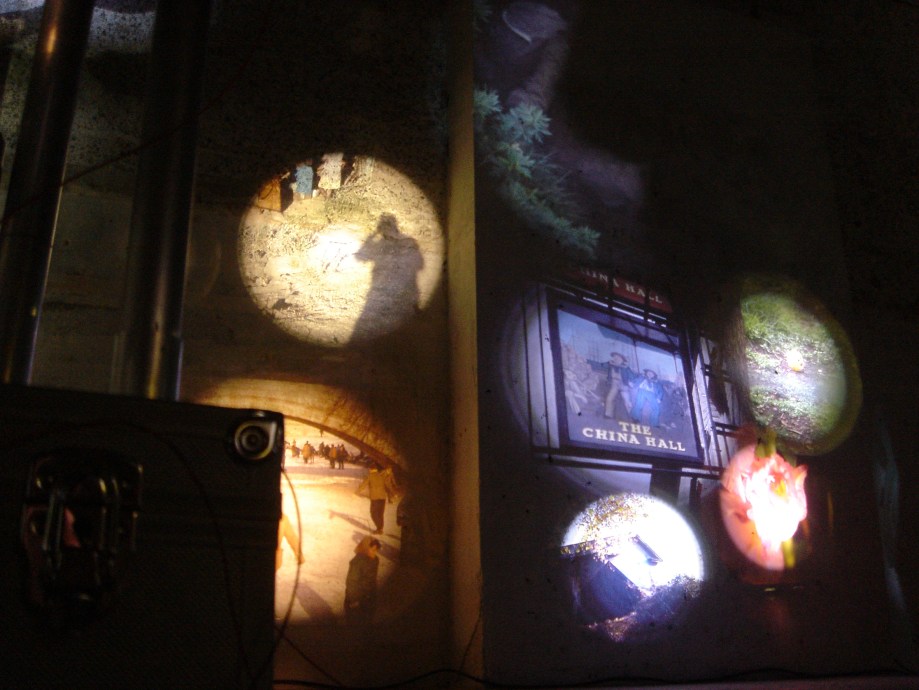
 Mark Ingham