Mapping Strange Assemblages The Unofficial Guide to ‘Everything Happens So Much’
Spark: UAL Creative Teaching and Learning Journal
Spark: UAL Creative Teaching and Learning Journal
Editorial
Dr Mark Ingham, Acting Programme Director Graphic Design Communication, London College of Communication
There is a story by Italo Calvino, The Baron in the Trees (1959), where a young Italian nobleman of the eighteenth-century rebels against his parents by climbing into the trees and remaining there for the rest of his life. After he has lived in the trees for a while, they become, ‘… hung all over with scrawled pieces of paper and bits of cardboard … with various objects; clusters of feathers, church candles, crowns of leaves… pistols, scales, tied to each other in certain order… served to jog his memory and make him realize that even the most uncommon ideas could be right.’ (Calvino, 1959, p.255).
This issue of Spark brings together an assemblage of provocative articles that have been a delight to read. Encountering these texts has led to me think about how we can come become even more thoughtful learners and teachers at UAL. What they all have in common is that they are uncommon. They are imaginative and creative thought experiments that deterritorialise our pedagogic practices (Nadler, 2015), and open up more spaces to help us become critical designers of our curricula and pedagogies. They help enliven the methods by which we can co-produce the ways and means our courses can be delivered.
In their text, ‘Arboreal pedagogy: Tree climbing for better learning’, Lewis Bush and Taylor Norton ask us to leave the classroom and climb trees, so that we might connect more closely with our students. This text jogged memories of my encounters in the 80s with the literature of Italo Calvino. Like in many of Calvino’s stories they take us on a provocative speculative journey where, ‘Arboreal pedagogy… while notional and in many respects completely impractical… is proposed here as an incitement against often unimaginative methods of teaching in art and design education’ (Bush and Norton, 2018, p.42). Lewis and Taylor consider it a,
…call for teachers to embrace creative and low-tech approaches to education that celebrate experiences that enrich the well-being and learning of students and staff alike […] education at its best can be simple, engaging and arboreal.
(ibid)
Provoked, I imagined a creative university of the future that has a forest as studio where we could book a branch for one-to-one tutorials, a tree for peer-to-peer learning, a copse for taking theory into practice and the arboretum for guest lectures. It is this sort of imaginative critical thinking that will help us create spaces for teaching and learning that are not based on classrooms of the 1850s, but suitable for the 2050s.
Francisco Gaspar in his article, ‘Verfremdungseffekt: Towards a critical Graphic Design education’, asks us if Graphic Design can be epic, more critical and dehabitualised, in order to question the assumptions about how we teach and learn in, with and about Graphic Design. In this thoughtful piece of writing Gaspar asks us not to do away with what we have already got, but to re-imagine the university as a site of critical engagement and resistance so we produce work that question the normative and help us make our world a better place to be. Through the idea of the Brechtian “defamiliarisation effect” Gaspar takes us on a journey back to the future, where he cleverly shows us that we already have the necessary critical tool kits in our universities to create academies that question the given and posit affective ideas and “things”.
Eleanor Dare, whilst the Technology-Enhanced Learning Coordinator at LCC, always kept my thinking about pedagogy from becoming lazy and falling into self-set traps, by questioning what may have looked on the surface like shiny, new teaching and learning ideas, which on closer inspection often turned out to be no more than false assumptions built on top of raggedy, worn out, old assumptions. In her provocation piece, ‘Out of the Humanist Matrix: Learning taxonomies beyond Bloom’, Dare challenges us to question long-held notions of where we get our ideas of best pedagogic practice from. Her article rips up the ground upon which we have constructed the digital in our programmes of study. By destabilising oft-cherished ideas Eleanor helps us become more ‘disruptive thinker[s]’ (Zweibleson, 2017 in Dare, 2018, p.49) about our pedagogy.
In Sarah Macdonald’s case study, ‘Citizens of somewhere: How a cross-cultural discussion group offers opportunities for intercultural understanding’, I was struck by her thought that, ‘Western culture’s perception of verbosity as a positive attribute is certainly not universal and it is understandable that some students faced with this attitude may find this challenging.’ (Macdonald, 2018, p.28). It made me wonder why we are uncomfortable with ‘uncomfortable silences’ (Tarantino, 1994) and how we can learn to live with silence as we become more empathic with someone from a culture that we do not know. Discussing ‘The Conversation Club’ at LCC, Sarah describes its aim to give us all greater ‘intercultural competence’ (Macdonald, 2018, p.30) and not to make the assumption that acquisition of linguistic fluency automatically means that criticality will follow. I hope that the ideas that have been learnt from this very thoughtful initiative can be used in all our classes to help us comfortably enjoy the silences and not to move away towards those we already know we can ‘yak with’. I share Sarah’s aspiration that,
As students from different cultures meet and are exposed to a variety of ideas, there will always be new information shared and new perspectives gained. It is hoped that this interaction will help students develop more intercultural awareness and send them on their way to become global citizens.
(Macdonald, 2018, p.31)
Neil Drabble’s research paper, ‘It’s all about ‘me’, with you: Exploring auto-ethnographic methodology’ resonated when he described his conversational approach. Neil’s research allowed him to use auto-ethnographic approaches and to amalgamate his collection of dialogues into a playful fictional form of storytelling. They represent philosophical thought experiments and fictive narrative philosophy. For me, his imagined conversations about pedagogical practices open up critical thinking about thinking.
One way to start a conversation is to see it as a way knowledge can be exchanged. We often forget to ask, “what can you teach me?”, rather than “this is what I am going to teach you”. In the case study, ‘SAKE: Student-led, skills-based workshops to support inclusivity within the creative curriculum’, Michelle Wild shows us that, ‘peer learning brought people together, developed a sense of community and built positive communications’ (Wild, 2018, p.37). The Skills and Knowledge Exchange workshops that Michelle describe in this article acknowledge that students bring with them to university particular knowledge and understanding that if facilitated skilfully in peer-to-peer learning environments, can add to the plurality of a group’s thinking about a subject.
Ngọc Triệu, a recent alumna of the BA (Hons) Design Management and Cultures Course at LCC often wonders and wanders. She explores cities she knows well and knows by encounter by drifting through them using pyschogeographic methods so they become known, yet still stay strange. In the text based on her final year thesis ‘Inside, in between and out: How can psychogeography be beneficial to teaching and learning in Higher Education?’ she references an article previously published in Spark, ‘A journey around my classroom: The psychogeography of learning spaces’ (Lange, Reynolds and White, 2016). Ngọc quotes from an interview she conducted with Silke Lange that gets to the heart of the matter,
It is about breaking a habit and being open to experiments… If you walk the same route every day from home to work, you just switch off and you don’t look anymore because you’ve seen everything. But if you just make an effort of going in different route everyday, you will experience the world very differently. And I think you can translate that kind of experience to a way of living: be open, try different things, don’t just get stuck in one way, in the system… It is about challenging yourself and becoming consciously aware of how you engage differently with spaces.
(Lange, 2017)
Ngọc argues that, ‘psychogeography practice is an act of acceptance, a way of befriending the uncertainty and embracing the beauty of everyday knowns and unknowns.’ (Triệu, 2018, p.62).
In his mixed media case study submission, ‘‘On the spectrum’ within art and design academic practice’, Luca Damiani gives us his video ‘My Aspie Hacks the Brain’, which he describes as, ‘Attempting to represent my neurological flow, the video explores my relationship to my surroundings and the way I process phenomena internally’. Luca by sharing with us, ‘…the idea of being neurodivergent within a creative academic environment’ helps ‘create an engagement at all levels of academic practice bringing qualities and abilities into the surface, and opening diverse conversations on the topic, looking at the potential of an inclusive society’. He makes us aware that the strength of any organisation is its ability to be diverse and to recognise diversity as a critically creative way to understand how to construct radical pedagogies.
As the guest editor of this issue of Spark and editorial board member I believe that one of its functions is to frame and lead the debates in the thinking and practice of creative higher education teaching and learning. This issue in an exemplar of how we can open up the multiple ‘pockets of good practice’ (Orr, 2016, p.1) we have at UAL, showing us how we can start to sew them together for the benefit of all our staff and students.
References
Calvino, I. (1959/2017) The baron in the trees. New York: Mariner Books.
Lange, S., Reynolds, R. and White, D. (2016) ‘A journey around my classroom: The psychogeography of learning spaces’, Spark: UAL Creative Teaching and Learning Journal, 1(2), pp.122–129. Available at: https://sparkjournal.arts.ac.uk/index.php/spark/article/view/25(Accessed: 21 January 2018).
Nadler, C. (2015) ‘Deterritorializing disciplinarity: Toward an immanent pedagogy’, Cultural Studies <=>Critical Methodologies. 15(2), pp. 145-152, https://doi.org/10.1177/1532708614563789
Orr, S. (2016) ‘Preface’, Spark: UAL Creative Teaching and Learning Journal, 1(1), p.1. Available at: https://sparkjournal.arts.ac.uk/index.php/spark/article/view/7/11 (Accessed: 14 January 2018).
Tarantino, Q. (1999) Pulp Fiction: Screenplay. London: Faber & Faber.
Biography
Dr Mark Ingham is a Senior Lecturer and UAL Teaching Scholar in the Design School at London College of Communication. For the last two years Mark has been an acting Programme Director for Contextual and Theoretical Studies, Spatial Design Communication, Branding Design Innovation and most recently Graphic Design Communication. His pedagogical and creative research are entangled encounters with: images of thought and memory, rhizomatic and meta-cognitive learning theories, fuzzy narratives and virtual and physical liminal teaching spaces.
Copyright (c) 2018 Dr Mark Ingham
 This work is licensed under a Creative Commons Attribution-NonCommercial 4.0 International License
Mapping Strange Assemblages
Mapping Strange Assemblages

“A series of encounters run by current and former LCC students who will provide performative educational experiences for visitors attending the exhibition. This ‘Band of Students’ will help visitors critically map out the multiple territories of the exhibition. They will manage and operate a number of daily and weekly provocative events that respond to the ideas, work and spaces involved. They, the BoS, will act as guides to create ‘lines of flight’ as they flow through the show. Let them entertain you and entangle you in their assemblage of mappings.”
#uncertainty #design #education #art #communication #twitter #entertainment #politics #universities #maps #futurism #geopolitics #transformations
+
EVERYTHING HAPPENS SO MUCH
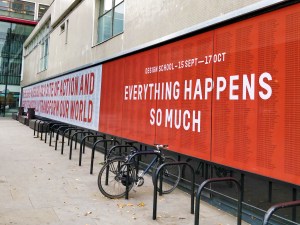

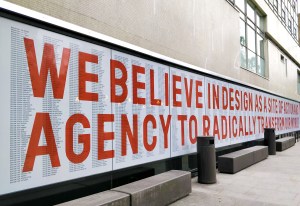
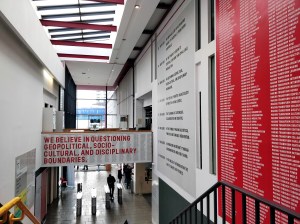
Join us to celebrate the opening of London College of Communication Design School’s ‘Everything Happens So Much’ exhibition and series of events. We have a keynote from Sarah Weir OBE, CEO Design Council where we discuss ‘The Design Economy 2018; the state of design in the UK’; followed by a series of performances/activities from exhibition participants. We launch our new Design School Manifesto, a call to action that is never closed and always in flux; and a new research platform called Supra Systems Studio, which interrogates the politics of networked technologies. We uncover new directions in service design, explore the concept of velocity in the context of contemporary culture, delve into the UAL Archives for a display of mini-comics, and much, much more…
Explore the College’s galleries and the spaces between. Immerse yourself in open processes, research and experiments that respond to the current condition of intense activity and accelerated change where ‘Everything Happens So Much’, part of London Design Festival.
https://www.eventbrite.co.uk/e/everything-happens-so-much-launch-night-tickets-48365162503
Wednesday 19 September 2018 6-9pm
London College of Communication
Elephant & Castle
London SE1 6SB
Alumni event on Tuesday 18th September 6-8.30pm (and invite your former students) and the Launch Night on Wednesday 19th September 6-9pm
Alummi Event booking link: https://www.eventbrite.co.uk/e/lcc-design-school-presents-everything-happens-so-much-alumni-event-tickets-48835337810
Launch Night booking link: https://www.eventbrite.co.uk/e/everything-happens-so-much-launch-night-tickets-48365162503
MY WORK USED BY OTHERS

‘Boy Pool Rhizome’ 1998-2000
Book covers
• Drawing Boy Pool Rhizome used as Cover art for: The Polyphonic Machine: Capitalism, Political Violence, and Resistance in Contemporary Argentine Literature. (2018). By Niall H. D. Geraghty. University of Pittsburgh Press. 2018.
• Drawing Boy Pool Rhizome used for PhD cover art. ‘science and technology studies, spatial politics and future making’. Requested by Dan Kristian Kristensen. 2017.
• Drawing Boy Pool Rhizome used for PhD cover art . The power of form: Swarming resistance in cyberspace’. Requested by Imogen Armstrong SOAS. 2016.
Book illustrations
• Drawing Boy Pool Rhizome used in Degrees of mixture, degrees of freedom: genomics, multiculturalism and race in Latin America, By Professor Peter Wade, British Academy Wolfson Research Professor. Published by Duke University Press. 2017.
Posters
• Drawing Boy Pool Rhizome used for: The Words of Others: Remembering and Writing Genocide as an Indirect Witness. By Caroline D. Laurent. (Used in defence of her PhD at Harvard University – Department of Romance Languages & Literatures). 2017.
• Drawing Boy Pool Rhizome used for a conference on Radical Democracy at The New School for Social Research. Requested by Signe Larsen – The New School for Social Research in New York. 2016.
Invites
• Boy Pool Rhizome used for ‘Contemporary Art in Coffee Shops’ Cincinnati, Ohio, USA, Requested by Mary Clare Rietz. 2016.
Online
• Becoming Rhizomatic used by Bibliothèque publique d’information (public library), in the Pompidou Center, Paris, for their online magazine, Balises. Requested by Fabienne Charraire. 2018.
Tattoos
• Drawing Boy Pool Rhizome to be used as a tattoo. Requested by Jasmin Degeling. 2017.
[spk] Vol 3, No 1 (2018)
Home > Archives > Vol 3, No 1 (2018)
[spk] Vol 3, No 1 (2018)
Vol 3, No 1 (2018)
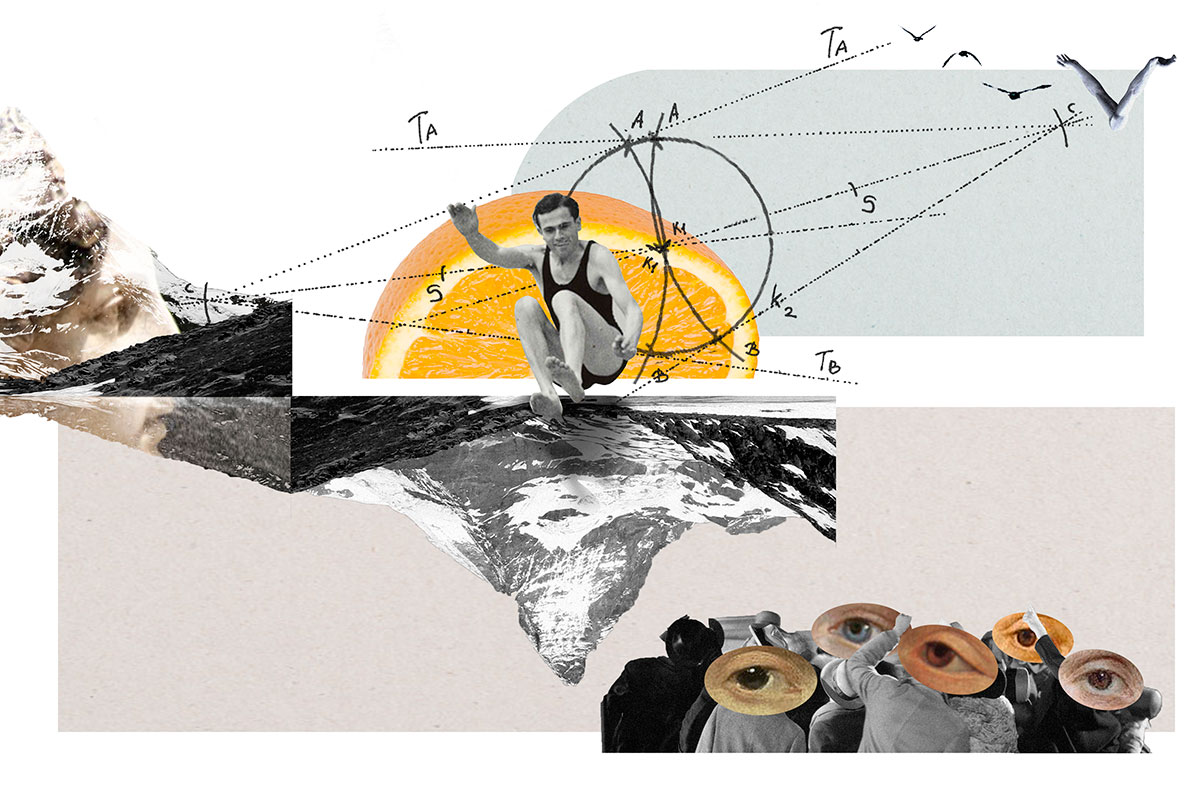
Illustration by Cristina Rosique, student on MA Graphic Media Design, London College of Communication, class of 2018.
Spark: UAL Creative Teaching and Learning Journal
Home > Vol 3, No 1 (2018) > Ingham
Editorial
Dr Mark Ingham, Acting Programme Director Graphic Design Communication, London College of Communication
There is a story by Italo Calvino, The Baron in the Trees (1959), where a young Italian nobleman of the eighteenth-century rebels against his parents by climbing into the trees and remaining there for the rest of his life. After he has lived in the trees for a while, they become, ‘… hung all over with scrawled pieces of paper and bits of cardboard … with various objects; clusters of feathers, church candles, crowns of leaves… pistols, scales, tied to each other in certain order… served to jog his memory and make him realize that even the most uncommon ideas could be right.’ (Calvino, 1959, p.255).
This issue of Spark brings together an assemblage of provocative articles that have been a delight to read. Encountering these texts has led to me think about how we can come become even more thoughtful learners and teachers at UAL. What they all have in common is that they are uncommon. They are imaginative and creative thought experiments that deterritorialise our pedagogic practices (Nadler, 2015), and open up more spaces to help us become critical designers of our curricula and pedagogies. They help enliven the methods by which we can co-produce the ways and means our courses can be delivered.
In their text, ‘Arboreal pedagogy: Tree climbing for better learning’, Lewis Bush and Taylor Norton ask us to leave the classroom and climb trees, so that we might connect more closely with our students. This text jogged memories of my encounters in the 80s with the literature of Italo Calvino. Like in many of Calvino’s stories they take us on a provocative speculative journey where, ‘Arboreal pedagogy… while notional and in many respects completely impractical… is proposed here as an incitement against often unimaginative methods of teaching in art and design education’ (Bush and Norton, 2018, p.42). Lewis and Taylor consider it a,
…call for teachers to embrace creative and low-tech approaches to education that celebrate experiences that enrich the well-being and learning of students and staff alike […] education at its best can be simple, engaging and arboreal.
(ibid)
Provoked, I imagined a creative university of the future that has a forest as studio where we could book a branch for one-to-one tutorials, a tree for peer-to-peer learning, a copse for taking theory into practice and the arboretum for guest lectures. It is this sort of imaginative critical thinking that will help us create spaces for teaching and learning that are not based on classrooms of the 1850s, but suitable for the 2050s.
Francisco Gaspar in his article, ‘Verfremdungseffekt: Towards a critical Graphic Design education’, asks us if Graphic Design can be epic, more critical and dehabitualised, in order to question the assumptions about how we teach and learn in, with and about Graphic Design. In this thoughtful piece of writing Gaspar asks us not to do away with what we have already got, but to re-imagine the university as a site of critical engagement and resistance so we produce work that question the normative and help us make our world a better place to be. Through the idea of the Brechtian “defamiliarisation effect” Gaspar takes us on a journey back to the future, where he cleverly shows us that we already have the necessary critical tool kits in our universities to create academies that question the given and posit affective ideas and “things”.
Eleanor Dare, whilst the Technology-Enhanced Learning Coordinator at LCC, always kept my thinking about pedagogy from becoming lazy and falling into self-set traps, by questioning what may have looked on the surface like shiny, new teaching and learning ideas, which on closer inspection often turned out to be no more than false assumptions built on top of raggedy, worn out, old assumptions. In her provocation piece, ‘Out of the Humanist Matrix: Learning taxonomies beyond Bloom’, Dare challenges us to question long-held notions of where we get our ideas of best pedagogic practice from. Her article rips up the ground upon which we have constructed the digital in our programmes of study. By destabilising oft-cherished ideas Eleanor helps us become more ‘disruptive thinker[s]’ (Zweibleson, 2017 in Dare, 2018, p.49) about our pedagogy.
In Sarah Macdonald’s case study, ‘Citizens of somewhere: How a cross-cultural discussion group offers opportunities for intercultural understanding’, I was struck by her thought that, ‘Western culture’s perception of verbosity as a positive attribute is certainly not universal and it is understandable that some students faced with this attitude may find this challenging.’ (Macdonald, 2018, p.28). It made me wonder why we are uncomfortable with ‘uncomfortable silences’ (Tarantino, 1994) and how we can learn to live with silence as we become more empathic with someone from a culture that we do not know. Discussing ‘The Conversation Club’ at LCC, Sarah describes its aim to give us all greater ‘intercultural competence’ (Macdonald, 2018, p.30) and not to make the assumption that acquisition of linguistic fluency automatically means that criticality will follow. I hope that the ideas that have been learnt from this very thoughtful initiative can be used in all our classes to help us comfortably enjoy the silences and not to move away towards those we already know we can ‘yak with’. I share Sarah’s aspiration that,
As students from different cultures meet and are exposed to a variety of ideas, there will always be new information shared and new perspectives gained. It is hoped that this interaction will help students develop more intercultural awareness and send them on their way to become global citizens.
(Macdonald, 2018, p.31)
Neil Drabble’s research paper, ‘It’s all about ‘me’, with you: Exploring auto-ethnographic methodology’ resonated when he described his conversational approach. Neil’s research allowed him to use auto-ethnographic approaches and to amalgamate his collection of dialogues into a playful fictional form of storytelling. They represent philosophical thought experiments and fictive narrative philosophy. For me, his imagined conversations about pedagogical practices open up critical thinking about thinking.
One way to start a conversation is to see it as a way knowledge can be exchanged. We often forget to ask, “what can you teach me?”, rather than “this is what I am going to teach you”. In the case study, ‘SAKE: Student-led, skills-based workshops to support inclusivity within the creative curriculum’, Michelle Wild shows us that, ‘peer learning brought people together, developed a sense of community and built positive communications’ (Wild, 2018, p.37). The Skills and Knowledge Exchange workshops that Michelle describe in this article acknowledge that students bring with them to university particular knowledge and understanding that if facilitated skilfully in peer-to-peer learning environments, can add to the plurality of a group’s thinking about a subject.
Ngọc Triệu, a recent alumna of the BA (Hons) Design Management and Cultures Course at LCC often wonders and wanders. She explores cities she knows well and knows by encounter by drifting through them using pyschogeographic methods so they become known, yet still stay strange. In the text based on her final year thesis ‘Inside, in between and out: How can psychogeography be beneficial to teaching and learning in Higher Education?’ she references an article previously published in Spark, ‘A journey around my classroom: The psychogeography of learning spaces’ (Lange, Reynolds and White, 2016). Ngọc quotes from an interview she conducted with Silke Lange that gets to the heart of the matter,
It is about breaking a habit and being open to experiments… If you walk the same route every day from home to work, you just switch off and you don’t look anymore because you’ve seen everything. But if you just make an effort of going in different route everyday, you will experience the world very differently. And I think you can translate that kind of experience to a way of living: be open, try different things, don’t just get stuck in one way, in the system… It is about challenging yourself and becoming consciously aware of how you engage differently with spaces.
(Lange, 2017)
Ngọc argues that, ‘psychogeography practice is an act of acceptance, a way of befriending the uncertainty and embracing the beauty of everyday knowns and unknowns.’ (Triệu, 2018, p.62).
In his mixed media case study submission, ‘‘On the spectrum’ within art and design academic practice’, Luca Damiani gives us his video ‘My Aspie Hacks the Brain’, which he describes as, ‘Attempting to represent my neurological flow, the video explores my relationship to my surroundings and the way I process phenomena internally’. Luca by sharing with us, ‘…the idea of being neurodivergent within a creative academic environment’ helps ‘create an engagement at all levels of academic practice bringing qualities and abilities into the surface, and opening diverse conversations on the topic, looking at the potential of an inclusive society’. He makes us aware that the strength of any organisation is its ability to be diverse and to recognise diversity as a critically creative way to understand how to construct radical pedagogies.
As the guest editor of this issue of Spark and editorial board member I believe that one of its functions is to frame and lead the debates in the thinking and practice of creative higher education teaching and learning. This issue in an exemplar of how we can open up the multiple ‘pockets of good practice’ (Orr, 2016, p.1) we have at UAL, showing us how we can start to sew them together for the benefit of all our staff and students.
References
Calvino, I. (1959/2017) The baron in the trees. New York: Mariner Books.
Lange, S., Reynolds, R. and White, D. (2016) ‘A journey around my classroom: The psychogeography of learning spaces’, Spark: UAL Creative Teaching and Learning Journal, 1(2), pp.122–129. Available at: https://sparkjournal.arts.ac.uk/index.php/spark/article/view/25 (Accessed: 21 January 2018).
Nadler, C. (2015) ‘Deterritorializing disciplinarity: Toward an immanent pedagogy’, Cultural Studies <=>Critical Methodologies. 15(2), pp. 145-152, https://doi.org/10.1177/1532708614563789
Orr, S. (2016) ‘Preface’, Spark: UAL Creative Teaching and Learning Journal, 1(1), p.1. Available at: https://sparkjournal.arts.ac.uk/index.php/spark/article/view/7/11 (Accessed: 14 January 2018).
Tarantino, Q. (1999) Pulp Fiction: Screenplay. London: Faber & Faber.
Biography
Dr Mark Ingham is a Senior Lecturer and UAL Teaching Scholar in the Design School at London College of Communication. For the last two years Mark has been an acting Programme Director for Contextual and Theoretical Studies, Spatial Design Communication, Branding Design Innovation and most recently Graphic Design Communication. His pedagogical and creative research are entangled encounters with: images of thought and memory, rhizomatic and meta-cognitive learning theories, fuzzy narratives and virtual and physical liminal teaching spaces.
Copyright (c) 2018 Dr Mark Ingham

This work is licensed under a Creative Commons Attribution-NonCommercial 4.0 International License.
Article views: 104
 Mark Ingham