2013 in review

The WordPress.com stats helper monkeys prepared a 2013 annual report for this blog.

Here’s an excerpt:

A New York City subway train holds 1,200 people. This blog was viewed about 3,900 times in 2013. If it were a NYC subway train, it would take about 3 trips to carry that many people.

Click here to see the complete report.

”No Más”

BREAKING BAD, PROPS, TV & FILM
[M]aking Bad – Skull Boots Tips
AUGUST 9, 2013BREVARDDESIGNBOOT TIPS, BOOTS, BREAKING BAD, BREVARD, COUSINS, DANIEL MONCADA, KEITH RICHARDS, LUIS MONCADA, NO MAS, SEASON 3, SILVER, SKULL, STERLING, VINCE GILLIAN 3 COMMENTS

Episode Title: BREAKING BAD, PROPS, TV & FILM
[M]aking Bad – Skull Boots Tips
AUGUST 9, 2013BREVARDDESIGNBOOT TIPS, BOOTS, BREAKING BAD, BREVARD, COUSINS, DANIEL MONCADA, KEITH RICHARDS, LUIS MONCADA, NO MAS, SEASON 3, SILVER, SKULL, STERLING, VINCE GILLIAN 3 COMMENTS

Episode Title: ”No Más”

Original Air Date: March 21, 2010

Sterling Silver, boot tips for “The Cousins” shown here on the white boots before they were dyed. Bryan communicated with Vince Gilligan throughout the process of modeling the skull on these tips, with the original inspiration being Keith Richards’ signature skull ring. Oxidation of the silver highlights the details and gives the skulls their depth.

The Cousins wearing boots with skull boot tips

20131231-234559.jpg

20131231-234612.jpg

Original Air Date: March 21, 2010

Sterling Silver, boot tips for “The Cousins” shown here on the white boots before they were dyed. Bryan communicated with Vince Gilligan throughout the process of modeling the skull on these tips, with the original inspiration being Keith Richards’ signature skull ring. Oxidation of the silver highlights the details and gives the skulls their depth.

The Cousins wearing boots with skull boot tips

20131231-234559.jpg

20131231-234612.jpg

UAL: LCC BA (HONS) DESIGN CULTURES

In this section

Talking and writing about design: it’s what this course is all about. Combining history and theory with business skills and applied practice, BA (Hons) Design Cultures will give you an understanding of design history, global cultures and ethics and sustainability. You’ll also explore how you can use design to create positive change.

Design Cultures in the city, Frieze Art Fair Regents Park 2012

  • FACTS

  • CONTENT AND STRUCTURE

  • STAFF

  • CAREERS

  • ENTRY REQUIREMENTS

  • APPLY

‘…an ever changing, cavorting carousel, that documents the transitory lives that pass through our crystalline world.’

///

[text start]


‘..an ever always changing, cav, cav, cavor, cavorting carousel, that documents the transitory lives that pass, pass, pass, through our crystalline worlds.’

120 Days and Nights of STAGGERING + STAMMERING.

The young man at the beginning of Andrei Tarkovsky’s The Mirror stammers and stutters, and then learns not to.

My grandmother, Rose-Marie, staggers out of The China Hall Public House, The White Horse Tavern, The Crystal Tavern, The Eagle and never learns. In the icy wastes of the French Alps she dives into freezing lakes. Followed by my grandfather, without a St. Bernard dog for company. ‘Ice, No Brandy’. The very very late night Troy Bar in Soho always clings.

However far I try and get away from ‘Grey Gardens’ it still tugs me back to ‘Tea for Two’. Just tea for two and two for tea Just me for you Just tea for two and two for tea Just me for you.

Our lives are smeared throughout the world, recalled through disparate, dissolute, fragmentary images, sounds and memories.

On the 27 of December 1960 Marilyn Monroe gave birth to a baby boy. Two weeks earlier she had flown to the town of Pointe-à-Pierre in Trinidad and Tobago to give birth. The father is unknown. She gave it up for adoption immediately. A Mexican divorce was granted to Arthur Miller and Marilyn Monroe on January 24, 1961. The boy, weighing 6lbs and 12oz was adopted by Sheila and Stephen Ingham

120 Days and Nights of STAGGERING + STAMMERING is an installation that sucks in and spews out images of the people and surroundings it encounters, real or imaginary, wherever it happens to stumble: New York, London, Venice, Iquitos, Ocho Rios.

Consisting of old SLR film cameras and LED spotlights each of the 120 ‘projectors’ throws out images of people, events and the fabric surrounding wherever it is exhibited.  A dense flickering array of images negotiated and dictated by the space, can be projected into, onto and outwards of any given situation/site. They prefer shady aspects but can flourish during daylight hours too. The larger less bright images are made visible by the descending gloom of the night. The smaller, closer to the wall/ceiling/floor, ones can cope with the intensity of other light sources.

The projectors can be clumped together in one location or be spread around different locales as needs be. The audience is enveloped in and disrupts this cacophony of images, creating and destroying as they wander through and around them. Shadows will appear and obliterate the wall images only to reappear on the bodies of the transgressors. The images will be instantly recognisable, as they will depict places just passed through on the way to the exhibition site.

There will be temporal shifts occurring sometimes of mere days alongside others of an indeterminate age. Referents will be lost and gained throughout this encounter.

‘…an ever changing, cavorting carousel, that documents the transitory lives that pass through our crystalline world.’

The End The End To be continued…..

[text end]

///

///

The Universal Addressability of Dumb Things

The Universal Addressability of Dumb Things

20130622-094439.jpg

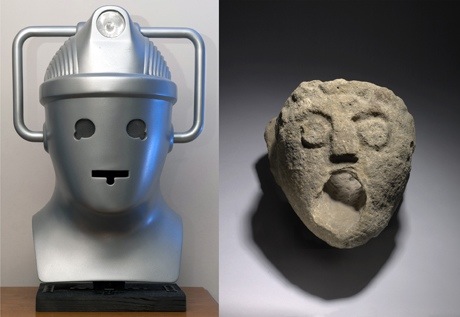
Cyberman with Gargoyle
Cyberman Helmet, 1985, Courtesy Chris Balcombe, Photo: Chris Balcombe
Singing Gargoyle, England, c. 1200, Courtesy of Sam Fogg, London

Curated by Mark Leckey

Turner Prize-winning artist Mark Leckey has curated an exhibition that explores the magical world of new technology, as well as tracing its connections to the beliefs of our distant past.

Historical and contemporary works of art, videos, machines, archaeological artefacts and iconic objects, like the giant inflatable cartoon figure of Felix the Cat – the first image ever transmitted on TV – inhabit an “enchanted landscape” created in the Pavilion’s galleries, where objects seem to be communicating with each other and with us.

In Leckey’s exhibition “magic is literally in the air.” It reflects on a world where technology can bring inanimate “things” to life. Where websites predict what we want, we can ask our mobile phones for directions and smart fridges suggest recipes, count calories and even switch on the oven. By digitising objects, it can also make them “disappear” from the material world, re-emerging in any place or era.

In this timeless exhibition, “the real and the virtual co-exist”, Leckey has said. Perhaps technology has created its own form of consciousness – an animistic future. While we already live in the realms of what used to be science fiction, we seem to have simultaneously gone back to our ancestral past – a time when ancient civilisations believed spirits inhabited plants, animals, geographic features and even objects.

Leckey’s theatre of “things” is presented in specially designed environments. Works by artists such as William Blake, Louise Bourgeois, Martin Creed, Richard Hamilton, Nicola Hicks, Jim Shaw and Tøyen are displayed alongside a medieval silver hand containing the bones of a saint, an electronic prosthetic hand that connects with Bluetooth, a bisected 3D model of Snoopy showing his internal organs, and many other treasures that all share connections. Loosely divided into four themes or scenes – the Vegetable World, Animal Kingdom, Mankind and the Technological Domain, Leckey’s exhibition is a collection of not-so-dumb things that all talk, literally or metaphorically, to each other.

Mark Leckey was born in Birkenhead in 1964. He currently teaches at Goldsmiths College, University of London. In 2008 he won the Turner Prize. Recent solo exhibitions include Work & Leisure at Manchester Art Gallery (2012), and See We Assemble at the Serpentine Gallery, London (2011). The Universal Addressability of Dumb Things is the latest in a series of artist-curated Hayward Touring exhibitions.

‘The status of objects’, Leckey argues, ‘is changing, and we are once again in thrall to an enchanted world full of transformations and correspondences, a wonderful instability between things animate and inanimate, animal and human, mental and material’. Our hyper-rationalism of modern technology has paradoxically produced its opposite, an ‘irrational’ magical realm – or as Marshall McLuhan, communication theorist, described “a resonating world akin to the old tribal echo chamber where magic will live again”.

A Hayward Touring exhibition from Southbank Centre, London

20130622-094236.jpg

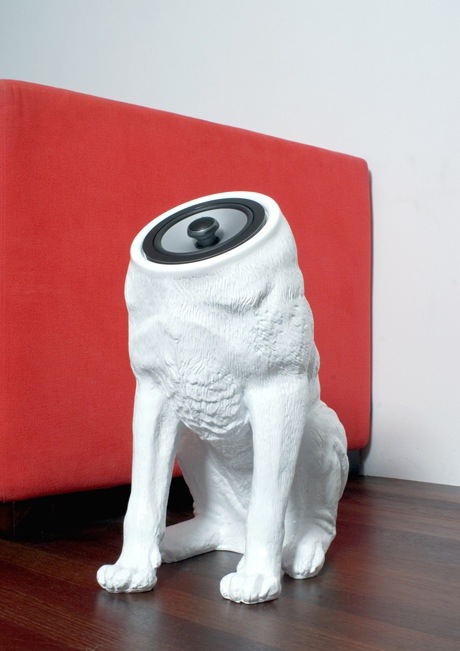
Woofer Design by Sander Mulder
© Sander Mulder

De La Warr Pavilion
Marina
Bexhill On Sea
East Sussex
TN40 1DP
Box Office and information:
01424 229 111 or boxoffice@dlwp.com

Sat 13 Jul 2013-
Sun 20 Oct 2013
Tickets: Free entry

Booking & Information:
01424 229 111

///