


///
Dilston Grove
“The Grade II former Church of the Epiphany on Dilston Grove (built in 1911) is located in the south west corner of Southwark Park, London. It is a distinguished work of Tuscan appearance by Sir John Simpson and Maxwell Ayrton (Empire Stadium Wembley) mainly in monolithic self-finished site-cast concrete and believed to be the only one of its kind in the country. Nothing however remains of the original interior. Since 1999, the Bermondsey Artists’ Group had brought the church back to life as one of the most important raw spaces in London for installations, site specific experimental art and as the only artists’ run gallery in London.”
Walter Menteth Architects – Dilston Grove
///
Back to Works
///
REVIEW in INTERFACE
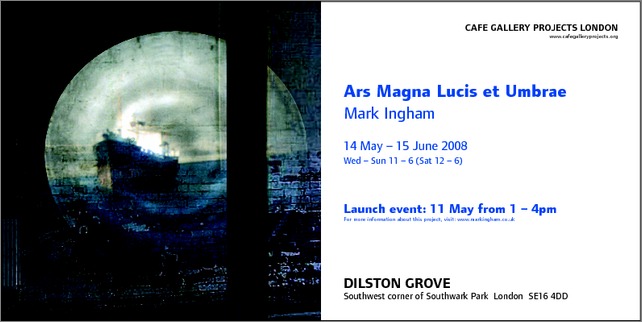
Ars Magna Lucis et Umbrae
Dilston Grove, Southwark
14 May 2007 – 15 June 2008
Reviewed by: Sharon Mangion » http://www.a-n.co.uk/interface/reviews/single/439162
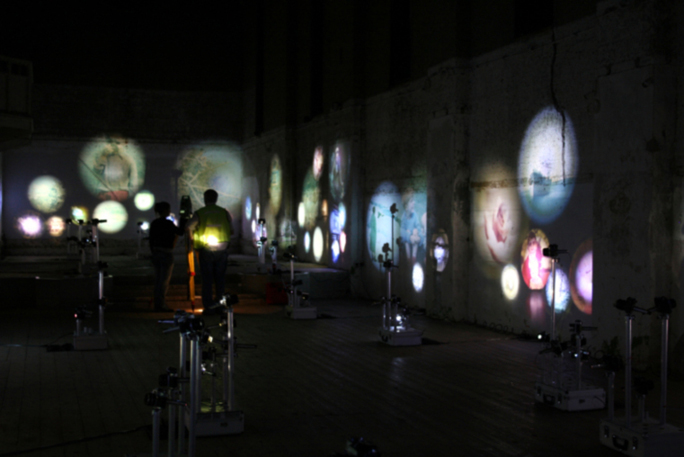
Dilston Grove, a former church on the edge of Southwark Park, as a venue for staging art installations, is fantastically evocative A dark cavernous space that conjures up gothic specters, it is an ideal space to explore the metaphysics of light. Mark Ingham’s Ars Magna Lucis et Umbrae showing until 15th June fills the space with jewel-like light projections that directly reference Althanasius Kircher’s (1646) tome on light and shadow.
With 100 or more projected images taken from his family album dispersed amongst others exploring the site in which the church stands, a magical homage to childhood memory is created. A fragile interplay of place and time is suspended in spheres of coloured light that point to the question of how far images can be considered local, universal, ideational or concrete. The threshold between light and dark is mediated by the grainy effect of the degrading walls the images are projected on, with flaking paint and gravel protruding into the images to remind the viewer of the real stuff of surfaces.
What is interesting about this show is the technology needed to create the projected images. Echoing Kircher’s use of the camera obscura as a kind of technological expression of light, SLR cameras are used instead to evoke the idea of a recording device that captures time as well as light. Kircher’s ‘magic lanterns’ have become time machines that use light to navigate through space.
I found it interesting to discover a few years ago while studying psychology, that autistic children are more able to determine what others are thinking, something they normally have difficulty with, if they imagine perceiving them through a camera. The camera acts as a kind of hidden eye for the child. This show also brings to mind the idea in science that any empirically valid result must to some extent reflect the apparatus by which it is tested with; a phenomenon also present in the theory of quantum mechanics, where it is the perceiving apparatus that is thought to collapse the wave function.
All of this, while a long way from Kircher’s interest in the camera obscura as an expression of the metaphysical aspects of light and dark, brings to my mind an interest in methodology that avoids being anachronistic. Instead a historical and a more personal lineage run parallel to each other with up to date technology, although not quite digital, but then the importance of the SLR’s role in projecting the same photographs taken years ago is an important aspect of the work.
As projection devices the number of cameras needed to create the effect maybe a bit overstated, but, achieve a beautiful decorative patina on the church walls all the same. The juxtaposition and overlaying of images in the mind make up our own personal patina of memories and using transparencies to project such memories for public viewing crosses a liminal threshold between the public and private that perhaps only photography can get away with. It also raises the question of how memory relies on artifacts such as the photograph to reify its existence and vice versa, how the photograph relies on us to project meaning into it.
The photograph can be both a hermetically sealed object and a universally vacant image all at once and this dichotomy is heightened by emphasizing its light projected qualities. Projection as a Freudian concept is thought of as a subconscious externalisation of aspects of the self that the personality cannot quite integrate into consciousness. I like the idea that public access to these photographs can mediate a shared sense of loss for histories that are both personal and collectively understood. But it also reminds me that memory, at its most formal, is an aesthetic phenomenon where projected light is etched onto the mind as colour via the spherical shape of the iris, blink and certain aspects of the image are missed and it all disappears in a second. When the camera shutter blinks, however, light is captured and leaves a legacy that can be put to various expressive uses, whether personal, political, philosophical, theological, technological, the list could go on.
This show takes a fascinating look at how visual artifacts struggle to transcend time and place and must be considered within a long historical tradition of explorations into light and dark.
sharon@mangion.fsnet.co.uk| www.sharonmangion.co.uk
Venue detail:
Dilston Grove
Southwest of Southwark Park, London SE16 2UA
///
Ars magna lucis et umbrae
Abstract
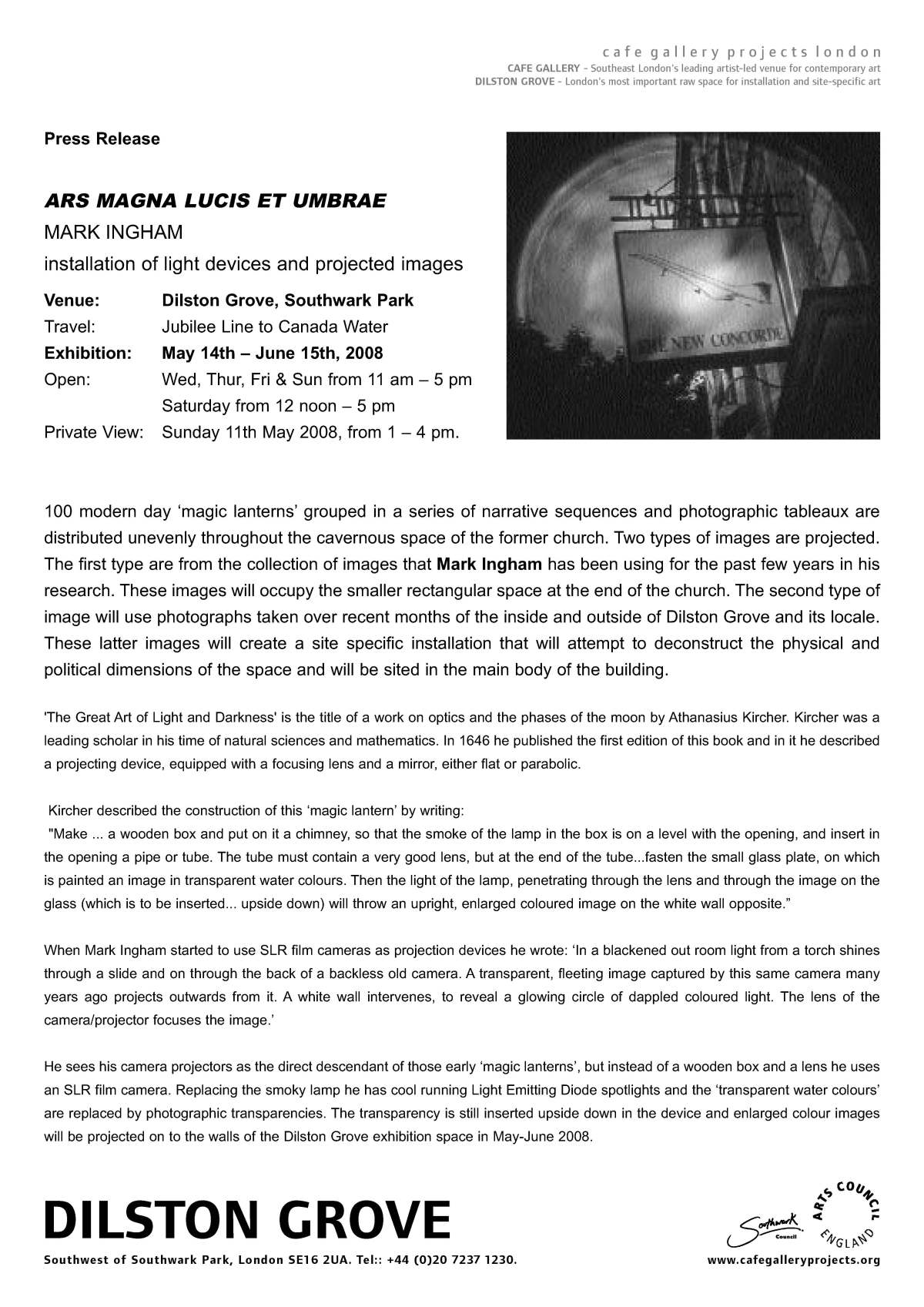
120 modern day ‘magic lanterns’ grouped in a series of narrative sequences and photographic tableaux are distributed unevenly throughout the cavernous space of the former church. Two types of images are projected. The first type are from the collection of images that Mark Ingham has been using for the past few years in his research. These images will occupy the smaller rectangular space at the end of the church. The second type of image will use photographs taken over recent months of the inside and outside of Dilston Grove and its locale. These latter images will create a site specific installation that will attempt to deconstruct the physical and political dimensions of the space and will be sited in the main body of the building. ‘The Great Art of Light and Darkness’ is the title of a work on optics and the phases of the moon by Athanasius Kircher. Kircher was a leading scholar in his time of natural sciences and mathematics. In 1646 he published the first edition of this book and in it he described a projecting device, equipped with a focusing lens and a mirror, either flat or parabolic. Kircher described the construction of this ‘magic lantern’ by writing: “Make … a wooden box and put on it a chimney, so that the smoke of the lamp in the box is on a level with the opening, and insert in the opening a pipe or tube. The tube must contain a very good lens, but at the end of the tube…fasten the small glass plate, on which is painted an image in transparent water colours. Then the light of the lamp, penetrating through the lens and through the image on the glass (which is to be inserted… upside down) will throw an upright, enlarged coloured image on the white wall opposite.” When Mark Ingham started to use SLR film cameras as projection devices he wrote: ‘In a blackened out room light from a torch shines through a slide and on through the back of a backless old camera. A transparent, fleeting image captured by this same camera many years ago projects outwards from it. A white wall intervenes, to reveal a glowing circle of dappled coloured light. The lens of the camera/projector focuses the image.’ He sees his camera projectors as the direct descendant of those early ‘magic lanterns’, but instead of a wooden box and a lens he uses an SLR film camera. Replacing the smoky lamp he has cool running Light Emitting Diode spotlights and the ‘transparent water colours’ are replaced by photographic transparencies. The transparency is still inserted upside down in the device and enlarged colour images will be projected on to the walls of the Dilston Grove exhibition space in May-June 2008
Back to Works
///

///
///
 Mark Ingham